China’s Swap Curve Normalizes as Deflation Fears Begin to Ease
A distortion in China’s money market has vanished after persisting throughout this year, a nascent sign that investors expect the latest stimulus efforts to reflate the economy.
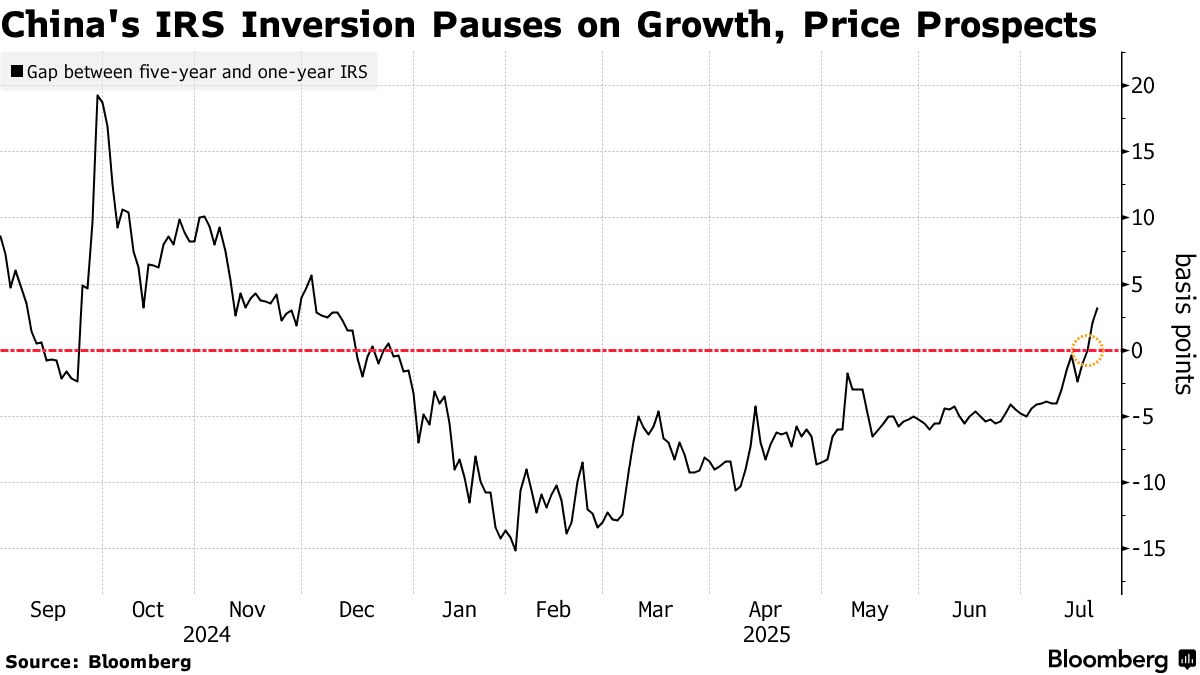
The country’s five-year interest-rate swaps , a popular hedging tool, climbed above their one-year counterpart on Friday and have since widened the gap to three basis points, according to data compiled by Bloomberg. That helped end a discount that was as steep as 15 basis points in February — when deflation fears were deeply entrenched.
The normalization — driven by a rise in the five-year rate and a drop in the one-year one — suggests expectations for less monetary easing over the longer term. Concerns over deflation have started to ease following Beijing’s “ ” campaign, which aims to curb industrial oversupply and cutthroat price competition and has started to feature more prominently in official policy messaging.
The latest swap trend “partly reflects potential impacts from this new round of supply-side reform — which will likely lift China out of deflation in the next 12-24 months,” said Becky Liu , head of China macro strategy at Standard Chartered Bank in Hong Kong. The market is less bearish on the longer-term outlook, but still pricing in rate cuts near term, she added.
China’s economy has also shown signs of amid US tariffs. The economy expanded 5.2% in the second quarter, exceeding analysts’ expectations of 5.1% and prompting at least international banks to raise their forecasts for this year.
While the swap curve was also inverted in the past including in 2013 and 2015, it has rarely persisted for more than a couple months. This year’s lengthy was partly driven by expectations of future monetary easing as investors anticipated prolonged deflation. That outlook dragged down the five-year IRS.
Such concerns appeared as producer prices fell the most since July 2023 last month — but have since given way to cautious optimism driven by hopes that supply-side reform will help lift prices. Another round of positive news arrived over the weekend, as China’s 1.2 trillion yuan ($167 billion) mega-dam in Tibet promises an economic jolt for sectors like construction, cement and steel.
“These are pressuring Chinese bond holders and encouraging traders to bet on higher IRS rates,” said Xing Zhaopeng , senior China strategist at Australia & New Zealand Banking Group Ltd. in Shanghai. “The rise of long-term rates may sustain into the future. The IRS curve steepening is just starting.”
The five-year IRS climbed two basis points to 1.55% on Monday, the highest since early April. The one-year IRS was steady after dropping two basis points last week.