BOJ Watchers Still Predict Next Rate Hike in October or January
Bank of Japan watchers increasingly expect authorities to raise the benchmark interest rate either in October or January, according to a Bloomberg survey conducted before US President Donald Trump announced a trade deal with Japan.
All 56 economists forecast Governor Kazuo Ueda ’s board will leave the benchmark rate at 0.5% at the July 31 conclusion of its next two-day policy meeting, according to the poll.
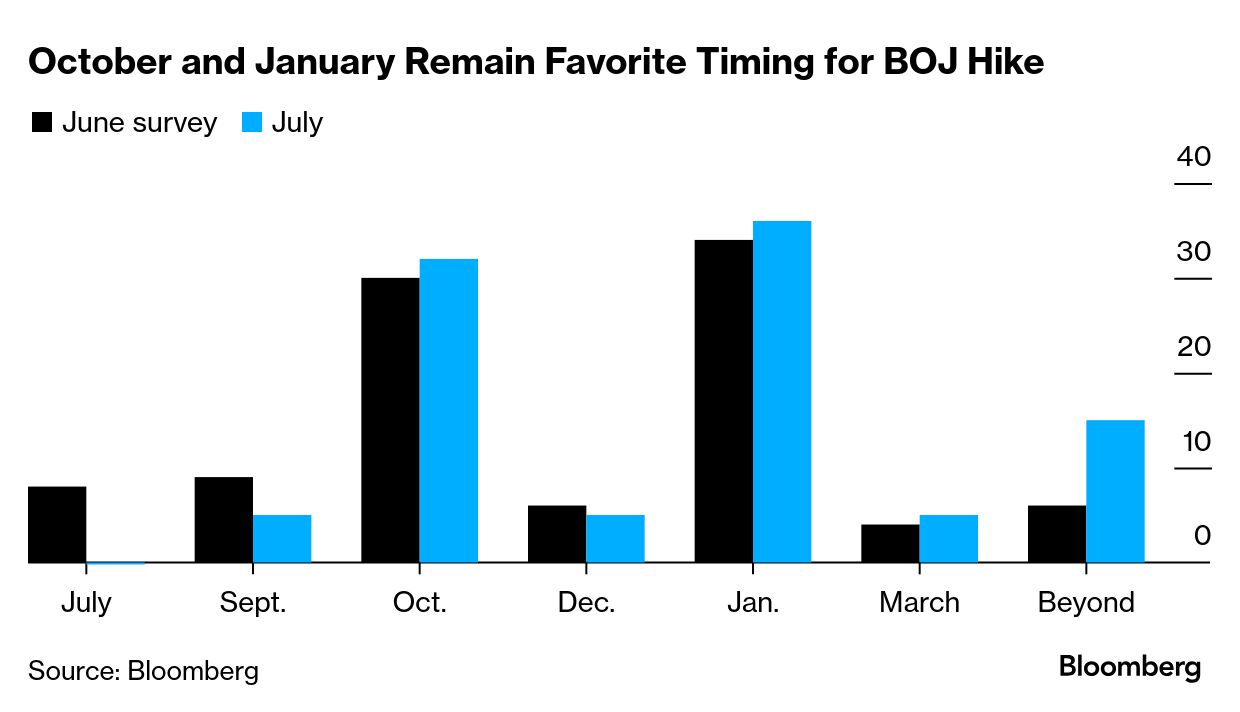
Those predicting the next rate action in October edged up to 32% from 30%, while the percentage seeing a move in January also slightly increased to 36% from 34%, the poll showed. In all, almost 80% anticipate a move by January.
Trump said Japan’s across-the-board tariff would be at 15%, down from the 25% rate that had been flagged to start from Aug. 1. The timing of the deal was much earlier than analysts had forecast, as only 12% expected a deal by Aug. 1. Ishiba said duties on US imports of Japanese cars would be reduced to 15% from 25% as part of the deal.
Read more: Toyota Leads Share Gains on Trade Deal With 15% Cars Tariff
“A rate hike is possible in September or October amid improvement in underlying inflation” if the tariff deal is reached by Aug. 1, Junya Takemoto , an economist at Sumitomo Mitsui Banking Corp. wrote in a survey response. “I’m paying attention to whether there will be the hint of a hawkish tone” in the BOJ’s assessment of inflation.
For full results of the survey, click here .
Speaking shortly after the trade deal was announced, Deputy Governor Shinichi Uchida said the agreement would boost the likelihood of the BOJ’s forecasts being met, a key condition for another rate hike.
With the outlook on tariffs now clearing, a primary focus of next week’s BOJ gathering will be its quarterly economic outlook report. As inflation has stayed at or above 3% this year, the BOJ is widely expected to raise its price outlook and revise its assessment of the risk balance for price growth.
“Inflation is running well ahead of the BOJ’s May forecasts,” said Marcel Thieliant , head of Asia-Pacific at Capital Economics. “While the bank will need to lift its inflation forecasts for the current fiscal year, the key question is whether it retains its downbeat forecasts for fiscal year 2026 and still sees downside risks.”
Ueda’s board will be debating monetary policy after Prime Minister Shigeru Ishiba ’s Liberal Democratic Party suffered a historic setback in Sunday’s upper house election that left Ishiba’s coalition without a majority in either house of parliament.
No BOJ watcher said the result of the vote would bring forward the timing of a rate hike. Some 35% said that it would push it back while almost the same ratio called it a neutral factor.
A key investor focus is the size of any fresh fiscal spending by the government after Ishiba’s party promised cash handouts to help households cope with elevated inflation. Many opposition parties called for the more costly step of lowering a sales tax for the first time, and the ruling coalition’s electoral setback makes it more vulnerable to opposition demands.
Analysts are divided as to whether the expected fiscal expansion will bring forward a rate hike. Roughly 30% said it would do so, while 20% said it would push the timing back. The rest said either the impact will be neutral or is hard to gauge.
“Given the result of the upper house election, momentum for fiscal expansion is likely to build up,” Hiroaki Muto , economist at Sumitomo Life Insurance Co. “The hurdle has gotten higher for the BOJ to hike rates further from the perspective of the policy mix” with the government.