Argentina Starts Building Up ‘Critically Low’ Cash Reserves

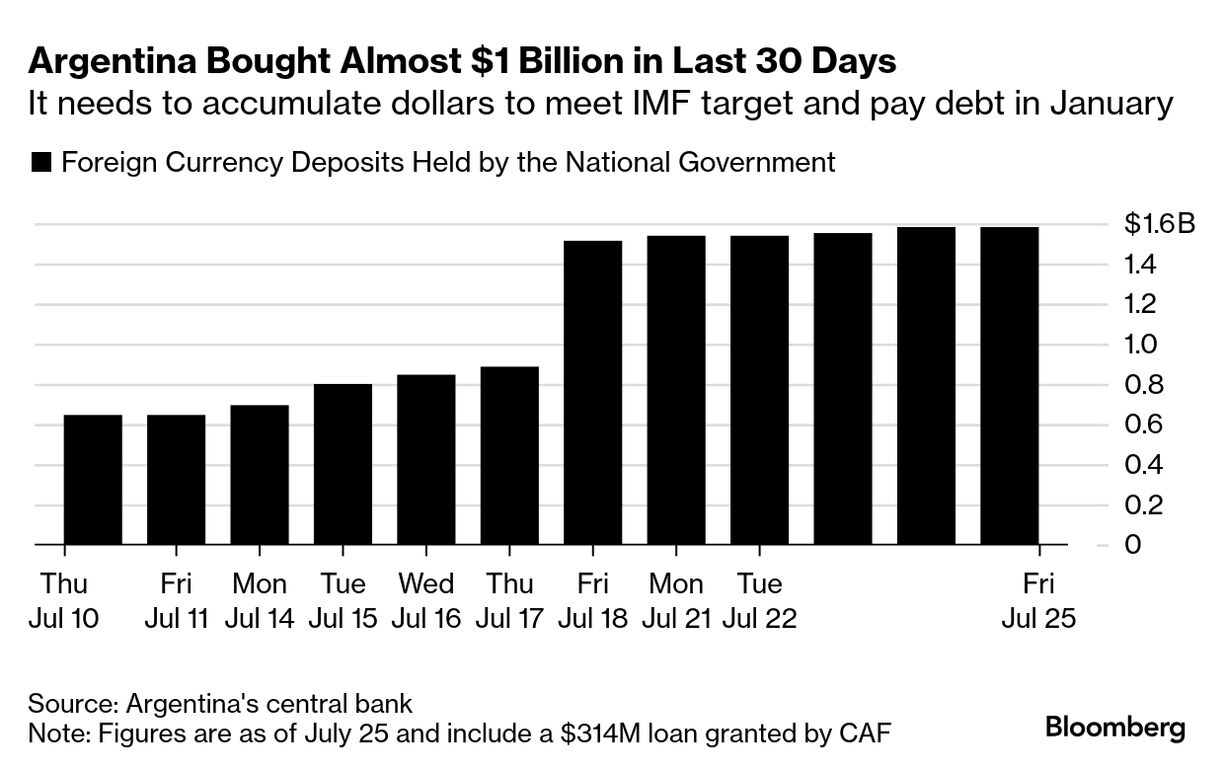
Argentina has swiftly changed its strategy for building up the central bank’s foreign reserves by buying $986 million since the end of June, foreshadowing policy updates in the country’s program with the International Monetary Fund.
The strategy pivot comes as the IMF warned in last week that despite a better economic framework, Argentina’s “net international reserves remain critically low.” In past years, depleted cash stockpiles have been a chronic issue of Argentina’s IMF programs that’s left the government without a buffer when currency selloffs arise.
President Javier Milei ’s policy tradeoff stands to help shore up the peso in the long term at the risk of letting it weaken further before the October midterm elections, potentially stoking some inflation, which remains near a five-year low. The currency has lost 8% against the dollar over the past month, the most in emerging markets, according to data compiled by Bloomberg.
The departure from Milei’s prior strategy — aimed at curbing inflation — and reflects mounting pressure to prepare for dollar debt payments due in January, as well as meet reserve targets in the $20 billion IMF deal. Economy Minister Luis Caputo , Argentina’s top negotiator, called the program’s latest version better than the original from April.
“I think it’s significantly going to help the country regain access to international markets to be able to refinance its debt,” he said last week on a podcast.
The central bank’s most recent figures show that it’s accumulated approximately $1.58 billion in reserves through July 25, with most of those purchased during the last 30 days.
The jump in net dollar purchases ends a three-month stretch during which authorities deliberately avoided accumulating reserves in order to prevent pushing pesos into the economy — a key element of Milei’s strategy to combat inflation, which recently hit a five-year low.
Javier Milei’s government stuck so firmly to that prior approach that analysts estimated it ultimately missed the June reserve accumulation target under the IMF agreement by at least $2 billion. At the same time, authorities raised $1.5 billion through the issuance of peso-denominated debt that could be subscribed in foreign currency, enabling the government to cobble together enough dollars needed to make a $4.5 billion sovereign bond payment on July 9. Argentina also owes a similar amount to bondholders in January.
Analysts say the shortfall of net reserves may have forced the IMF to grant a waiver on missing the deadline and will likely lead to a revision of the original targets. The staff-level report, which incorporates these details, is expected to be approved and published by IMF executive board sometime this week.
“The government reversed its strategy and resumed dollar purchases, suggesting this was a central issue in the IMF technical review,” economist Juan Manuel Truffa wrote in a client note for . “The target was most likely revised.”
Milei’s willingness to build up reserves reflects the dilemma Argentine presidents face between longer-term stability and short-term risks of stoking inflation by piling pesos into the financial system. However, peso liquidity and Milei’s tax cuts for commodity exports could encourage more dollar inflows to Argentina in the second half of the year, when greenbacks tend to dry up.
“The government appears more tolerant of FX volatility and is moving away from the corner it had painted itself into in the second quarter, aiming to better balance reserve accumulation with inflation control,” wrote Juan Manuel Pazos, chief economist at local broker One618, in a client note last week.