Chile Peso Tumbles on Central Bank’s Surprise Reserves Program
Chile’s peso tumbled Wednesday after the central bank announced plans to to build up its international reserves, surprising investors after it had repeatedly said it was comfortable with the level of foreign currency holdings.
The peso fell as much as 1.4% in early trading, leading losses in a basket of 23 developing-nation currencies tracked by Bloomberg.
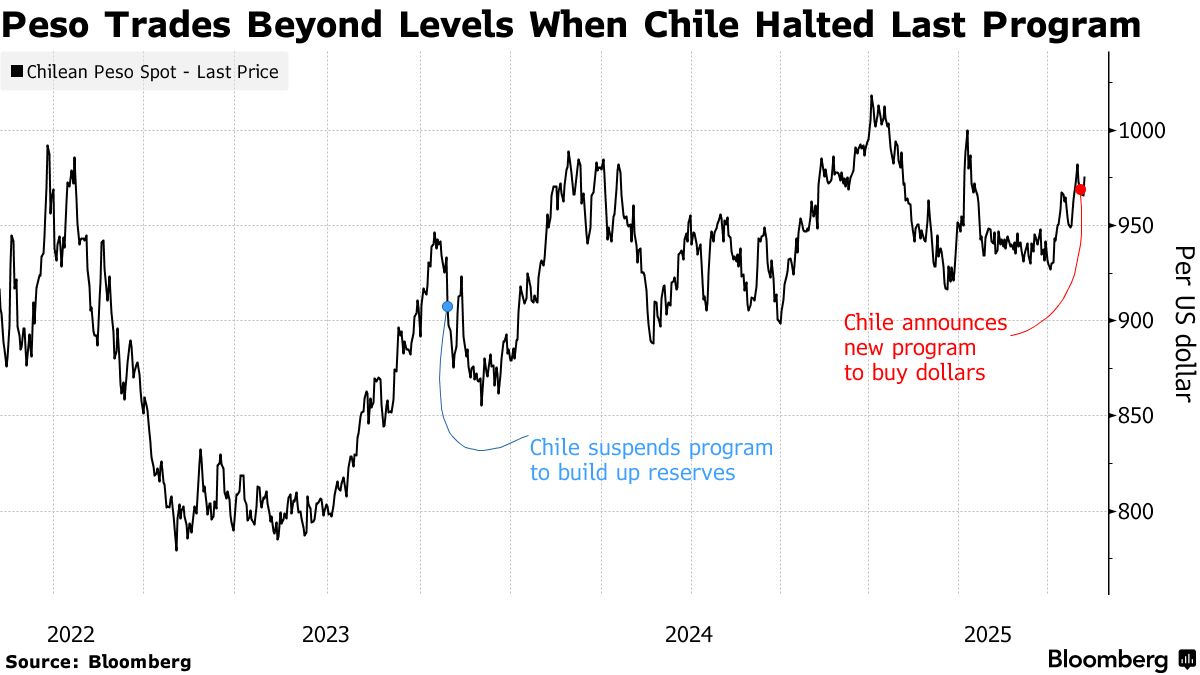
Late on Tuesday, the central bank it will buy up to $25 million per day to accumulate $18.5 billion over the next three years. The measure aims to gradually replace the current credit lines in foreign currency with the bank’s own international reserves, according to a statement. The plan, which will start on Aug. 8, does not aim to affect the behavior of the foreign exchange market, policymakers said.
“Timing is a bit surprising,” said Alejandro Cuadrado , head of global FX and Latin America strategy at Banco Bilbao Vizcaya Argentaria SA in New York. “Overall, in a close to USD1bn/daily volume market the impact should be limited but sets up a modest upward bias, with USDCLP980 still a resistance reference.”
The peso is already confronting global volatility from factors including swings in the price of copper, Chile’s main export, and also expectations for interest rate cuts by the Federal Reserve. Locally, the currency is under pressure from renewed . The announcement also comes after Governor Rosanna Costa said as recently as the central bank was comfortable with its level of international reserves.
Read more:
This is the third program in five years announced by the bank to build up its reserves. In June 2023, central bankers a plan to accumulate $10 billion through purchases of $40 million a day. That program was in October 2023 due to “growing tensions in global financial markets” after accumulating roughly $3.7 billion.
Back in January 2021, policymakers had said they planned to buy $40 million a day to build up reserves by $12 billion. That program fell by the wayside in October 2021 as volatility increased.
Chile’s central bank said the plan announced Tuesday will be reviewed every six months and that it can be modified if market conditions change.
Policymakers “perhaps want to smooth the impact with a lower daily quantity, but it does imply that the central bank wants to take advantage of the dollar weakening trend to build reserve,” said Ning Sun , a senior emerging-market strategist at State Street Global Markets in Boston.