PBOC Signals No Urgency for Rate Cuts Despite Poor Economic News
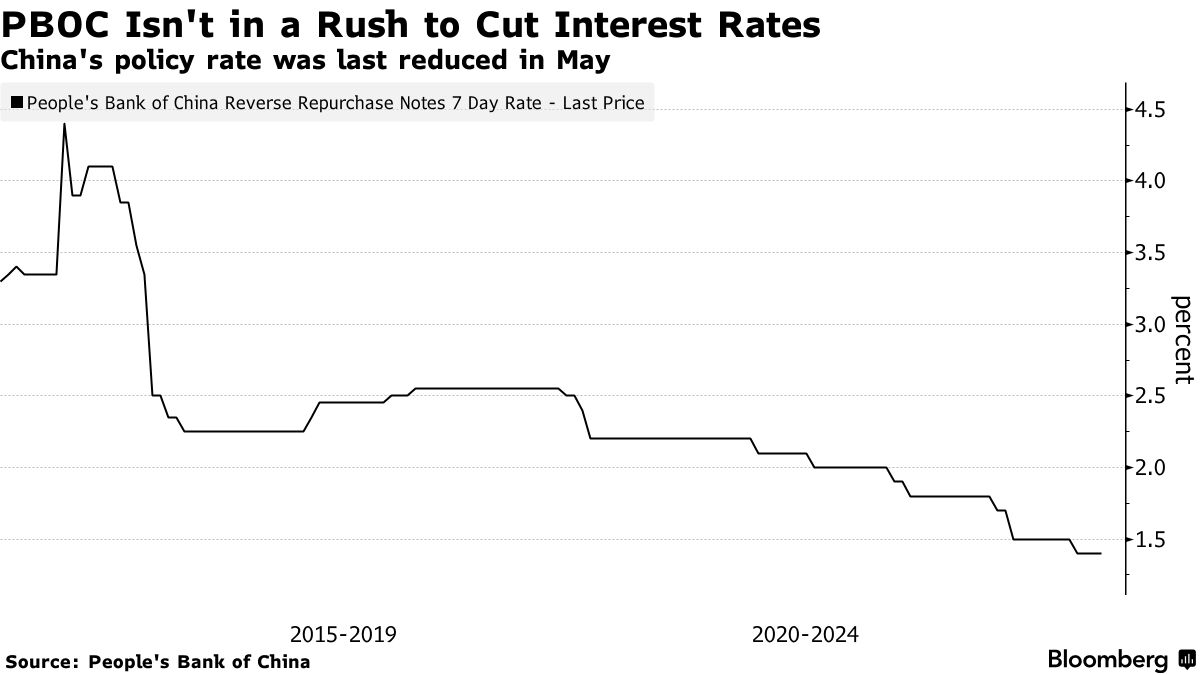
China’s central bank indicated it’s holding back from aggressively easing monetary policy with moves such as interest-rate cuts, even though the economy just recorded its worst month so far this year.
The People’s Bank of China pledged to “thoroughly” enact its “moderately loose” monetary policy while highlighting to the economy. The remarks in a quarterly report published late Friday followed shortly after disappointing offered evidence of weakening domestic demand.
Together with a message painting an improved outlook for inflation, the PBOC is signaling it’s likely to put off using broad easing tools like cuts to interest rates or the reserve requirement ratio for later this year when the economy risks a more significant slowdown, according to analysts at global banks including Citigroup Inc. The RRR determines the amount of cash lenders must set aside in reserves.
“Its emphasis on executing existing policies and targeted easing signaled limited appetite for broad-based monetary easing,” Goldman Sachs Group Inc. economists including Chen Xinquan wrote in a report.
China’s economy in July, as a campaign to curb overcapacity at home added to the sting of higher tariffs. Weaker stimulus for infrastructure and consumption was also a key culprit behind the slowdown, revealing the extent to which private demand remains frail.
But after posting a year-on-year gain in gross domestic product in the first half of 2025, China can probably tolerate slower growth in the second half and still deliver on the official target of around 5%.
“Structural policies could be a more important venue for the PBOC in the next few months compared with broad-based rate or RRR cuts,” Citigroup economists including Yu Xiangrong wrote in a report Sunday.
The economy faces a number of challenges including increasing trade barriers and insufficient domestic demand, but its foundation is solid and its resilience is strong, the PBOC said in the report.
When it comes to deflation , a problem that’s haunted China for more than two years, the PBOC highlighted that the core consumer price index , which excludes volatile food and energy items, has improved in recent months.
The government’s crackdown on “disorderly” low-price competition, along with a policy pivot to boosting consumption, will have positive impact on inflation, the PBOC said.
Economists generally anticipate the PBOC will deliver another rate cut of 10 to 20 basis points by the end of this year, as well as a 50-basis point RRR reduction.
Some analysts also expect the government to roll out additional fiscal stimulus if the economy weakens later this year. Citi forecasts a 500 billion yuan ($70 billion) quasi-fiscal injection to support demand.
In addition, the PBOC pledged to prevent funds from idly circulating within the financial system, indicating concern over financial stability and arbitrage. That’s another sign “the PBOC is in no rush for broad-based easing,” according to a report Saturday from Goldman Sachs.
The PBOC also revealed that it’s set up a macro-prudential and financial stability committee in January, heeding top officials’ call to strengthen its mandate.
The central bank expanded its reach in helping stabilize the property and stock markets in recent years, having facilitated a quasi-stabilization fund for equity purchases earlier this year.