Singapore’s UOB Sees Yuan Shortage as Southeast Asia Usage Soars
The Chinese yuan ’s limited offshore supply is posing operational challenges for , as more regional economies conduct trades and payments in the currency, according to an executive at the Singapore bank.
To boost yuan liquidity, UOB, which is the city-state’s third largest bank, has raised more deposits, turned to issuing panda bonds — or yuan-denominated notes issued by foreign borrowers in China’s onshore market — and increased activity in the foreign exchange swap market, Albert Yuan, the bank’s head of transaction banking for China and Hong Kong, said in an interview last week.
“Although we try our best to collect more deposits, it’s not enough to support the business growth,” said Yuan, who’s based in Shanghai.
Roughly 20% of total trade between China and Southeast Asia is transacted in yuan and this will likely continue to rise, he said. Offshore yuan deposits are tight, with only about 1.5 trillion yuan ($209 billion) held outside China as of end-2023, compared to roughly 321 trillion yuan in the onshore banking system, according to the People’s Bank of China’s latest available data.
UOB’s experience underscores a broader market distortion as companies consider pivoting away from the dollar amid rising US tariffs and China’s deepening engagement. The surge in e-commerce and intra-Asia trade in emerging technologies, such as electric vehicles, is further boosting demand for yuan as the gains traction.
In June, the bank joined China’s cross-border interbank payment system, or CIPS, as a direct participant, a move to speed up client transactions and improve settlement efficiency. Thailand’s was also one of the six banks at the time to join , which was founded in 2015 to promote international adoption of the yuan.
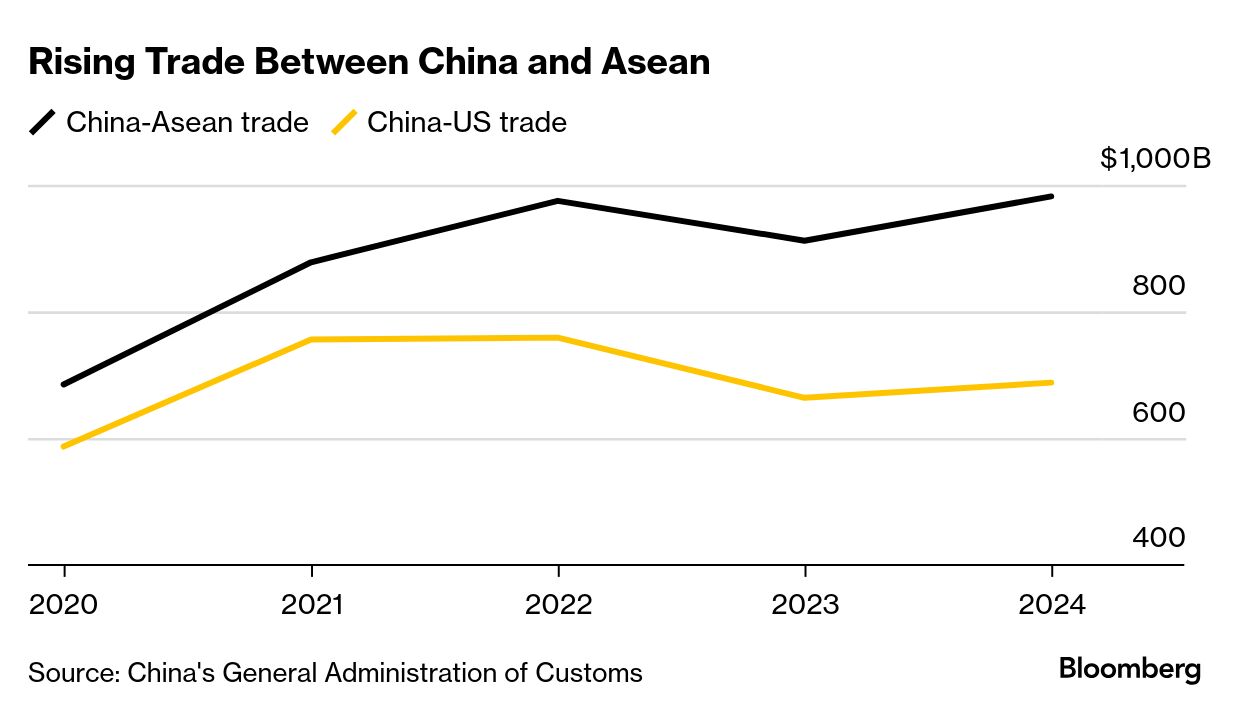
With yuan borrowing costs relatively lower than the dollar’s, regional trade has remained strong amid looming tariff hikes from Donald Trump. In the first seven months of the year, China’s trade with the 10 Asean member nations neared $600 billion — compared to $982.3 billion for all of 2024, according to Chinese customs data.
READ:
Yuan-denominated transactions in Thailand and Indonesia each spiked about 70% annually in both 2023 and 2024, according to UOB’s analysis of SWIFT data.
Still, UOB’s Yuan remains optimistic about long-term prospects. “We think the market for the yuan will increase significantly in the next decade,” he said.