Hedge Funds Clash With Asset Managers on Where Yen Is Heading
Hedge funds are betting on ever more weakness in the yen just as asset managers cling to bullish positions, augmenting the tussle on where Japan’s currency is headed.
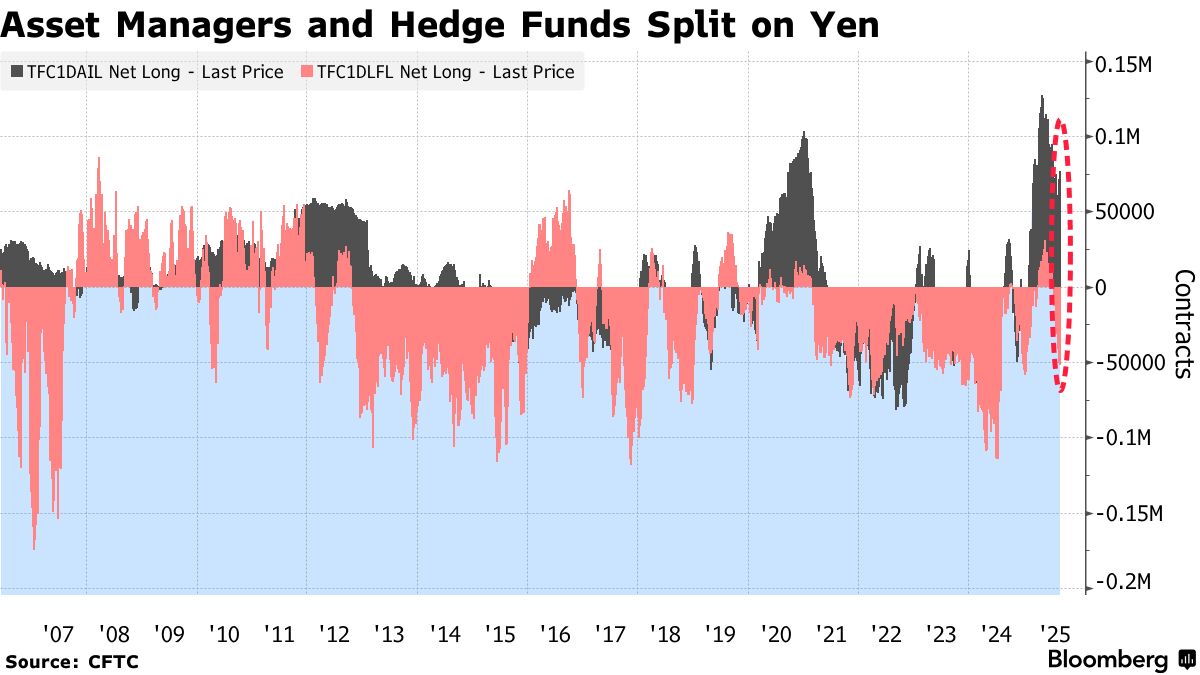
The split between asset managers buying the yen and leveraged funds that are selling rose this month to around the widest levels since 2007, weekly data from the Commodity Futures Trading Commission show.
The divergence underscores complexities around investing in the world’s currency as domestic political uncertainty muddies the Bank of Japan’s policy path. Japan has also been sucked into President Donald Trump’s global trade war, and that’s dented sentiment on the nation’s assets and the yen’s once-vaunted haven status.
“Hedge funds move fast and some may see Japan’s political risks and rate uncertainty as reasons to sell or use the yen as a funding currency,” said Shoki Omori , chief desk strategist at Mizuho Securities Co. “Some asset managers though may see the yen as cheap and hedging technicalities may mean some have to keep dollar-yen positions. The divergence can continue.”
The yen weakened 0.3% to trade at around 148.32 per dollar in Asia Monday.
Japan’s currency is one of the worst-performing Group-of-10 peers against the dollar this year, having advanced only about 6% against the greenback. The Swiss franc, a currency often compared with the yen, strengthened more than 13% against the dollar during the same period.
“Even if the BOJ raises rates, with real interest rates this low, some people are thinking it’s hard to envision the yen actually strengthening,” said Takuya Kanda , head of research at Gaitame.com Research Institute in Tokyo. “We’re in a situation where perspectives are divided.”
Hedge funds boosted bearish yen positions to a net 58,811 contracts days ahead of the BOJ’s latest rate decision, data ending the week of Sept. 16 show. Asset managers on the other hand pared back some bullish positions but clung to 71,162 contracts that profit from a strengthening yen.
The spread is currently the widest since 2012 and lingering near levels last seen in 2007, the data showed.
Japan’s central bank kept borrowing costs on on Friday, with officials still assessing the impact of US tariffs at home and abroad even after authorities managed to solidify the with Washington. Governor Kazuo Ueda also faced two dissenters against holding rates during the meeting, giving investors cause to reassess what that could bode for future policy moves and the yen.
For now though, both asset managers and hedge fund positions are “close to extremes but not yet at an extreme,” said Rodrigo Catril , strategist at National Australia Bank Ltd. in Sydney. This favors “the view that for now these positions can extend for a while longer.”