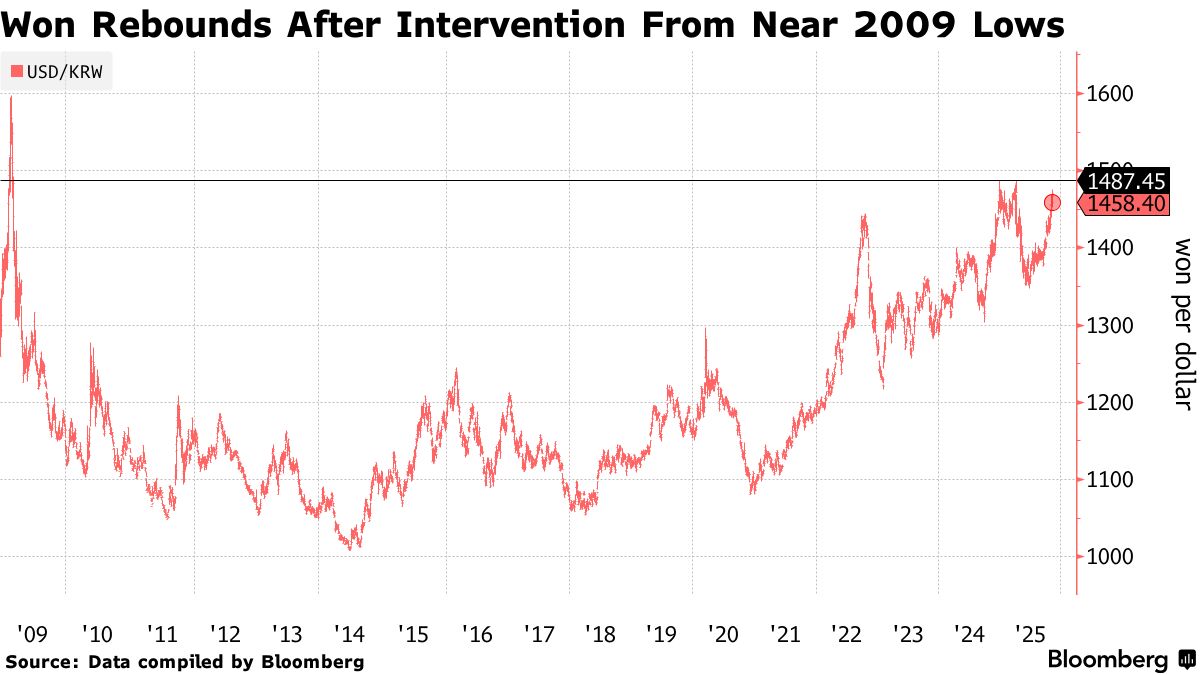
Won Outlook Improves as Intervention Adds to Analysts’ Views
Investors betting on a won rebound drew fresh support from Korean authorities’ latest , reinforcing expectations that stronger growth prospects and potential Federal Reserve easing will stem further losses.
Even before the Nov. 14 move, ING and Woori Bank projected the currency to rebound to about 1,400 and 1,420 per dollar, respectively, by the first quarter of 2026. The won, down 4% this quarter and near levels unseen since 2009, recovered to 1,451 won by day-end after authorities stepped in.
“We are positive on the Korean won and see the won to strengthen into year-end and into 2026, driven by improving growth recovery, less dovish Bank of Korea and most importantly, the optimism toward AI and tech,” said Wee Khoon Chong , senior market strategist at BNY.
The Korean won has mirrored Asian currency volatility amid global trade tensions this year. With tariff pressures easing and semiconductor exports gaining momentum, Korea’s economic outlook is strengthening. The latest pledge for more policy action may cement the currency’s rebound.
Despite eking out modest gains against the dollar this year, the won remains Asia’s weakest export-dependent currency. Volatility has intensified as foreign investors took profits from equities, and the won has also tracked the yen’s slide.
Korean corporates continue to invest overseas, while retail investors extend their appetite for US stocks, a source of dollar demand that authorities noted in their Nov. 14 remarks.
Korean officials said in their remarks that they will work with major market players, including the state-owned National Pension Service, to defend the won. The country’s largest institutional investor, with about $530 billion of foreign assets, has often helped counter currency pressure through hedging and foreign exchange operations.
Trade and Economy
The easing of US-Korea trade uncertainties, including lower tariffs, could prove supportive for the currency. Seoul’s $350 billion to invest in the US removes a key concern, and “could be financed from local dollar assets,” including the interest and dividend income from the Bank of Korea’s foreign exchange reserves, Goldman Sachs Group strategists including Kamakshya Trivedi wrote in a note.
Anticipated Fed rate cuts are expected to narrow differentials with Korea. That could reverse outbound flows from domestic investors, the Goldman Sachs strategists noted. “We still see a clear policy impulse pushing the currency stronger,” they added, shifting their near-term won outlook from neutral to bullish.
Bond Inclusion
Further support will come from FTSE Russell’s decision to add Korean bonds to its World Government Bond Index beginning April 2026, a move authorities highlighted in their Nov. 14 remarks. Barclays estimates the move could draw about $56 billion of inflows .
Such investments will “provide modest support for the currency in the first half,” said ING economist Min Joo Kang .
This week’s main economic events: