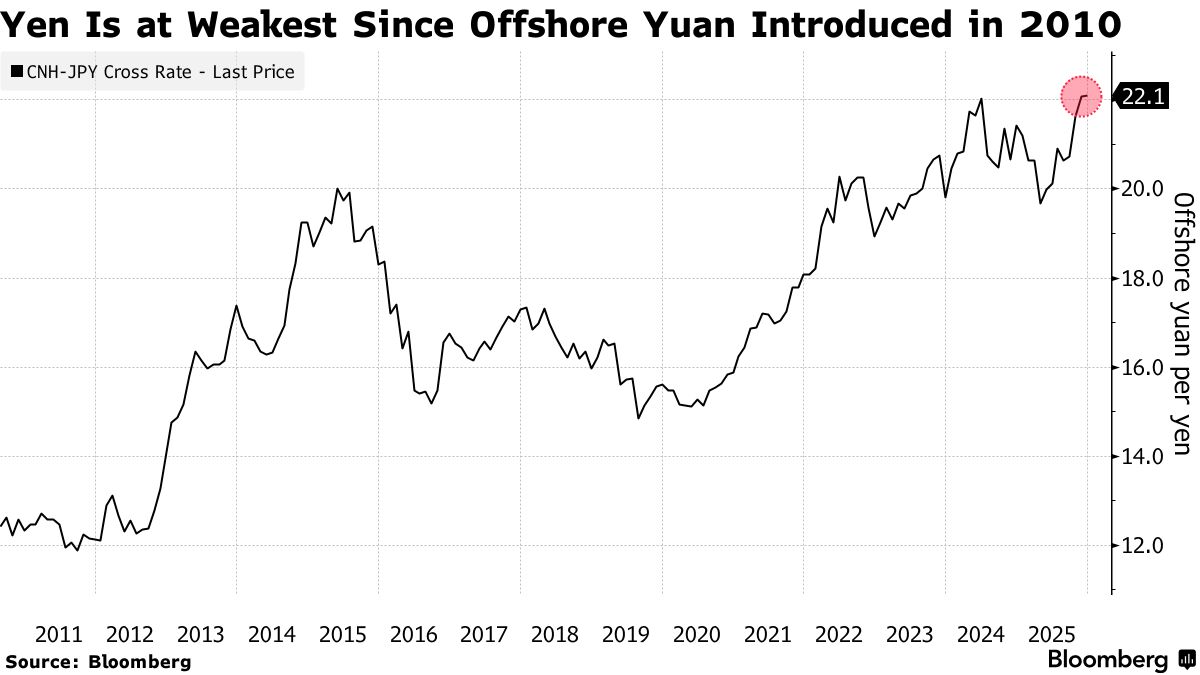
Yen’s Record Weakness Against Yuan Raises Japan Inflation Risks
The yen struck a record low against the offshore yuan this week, raising concerns about imported inflation in Japan where the central bank’s policy normalization remains gradual.
The Japanese currency has also weakened against China’s tightly managed onshore yuan, with the pair hovering near its lowest since 1992. The offshore yuan was introduced in 2010.
A cautious BOJ and lingering fiscal concerns are pressuring the yen, whose weakness has now broadened beyond the dollar and euro to include currencies of key trading partners such as China and Australia . The delay in normalizing monetary conditions keeps Japan’s real effective exchange rate near multi-decade lows and may amplify imported inflation pressures, given China is Japan’s largest source of imports, even amid simmering political .
“A weak yen is problematic because it increases inflation risk, which in turn is politically unpopular,” said Moh Siong Sim , FX strategist at Bank of Singapore. “The BOJ faces a delicate balancing act of curbing yen weakness while containing upward pressure on JGB yields.”
The BOJ is widely expected to raise interest rates by 25 basis points at next week’s policy meeting, with overnight index swaps pricing in a 92% chance of a move. And yet, investors are bearish yen bets, reflecting expectations Japan’s yields will remain substantially below those of the US even after a potential BOJ move.
Meanwhile, there are doubts Beijing will tolerate sustained gains in the yuan. A firmer currency supports capital inflows and China’s financial-opening goals, but excessive appreciation risks that are a critical pillar of the economy.
Traders will be watching whether the People’s Bank of China allows the recent offshore yuan’s gains to flow through in upcoming fixings , or if it will curb further appreciation.