UBS Asset Sees Yuan’s Path to 10% Share of Global Reserves
China stands to benefit if investors increase portfolio diversification amid escalating concerns over US policies, according to UBS Asset Management.
Should tensions involving the US intensify — with greater strains in the Treasury market and mounting attacks on the Federal Reserve that erode US credibility — the allocation target for the yuan’s share of global central bank foreign exchange reserves may rise to as much as 10% over the medium term, said Massimiliano Castelli , head of global sovereign markets strategy at the firm, in an interview in Shanghai.
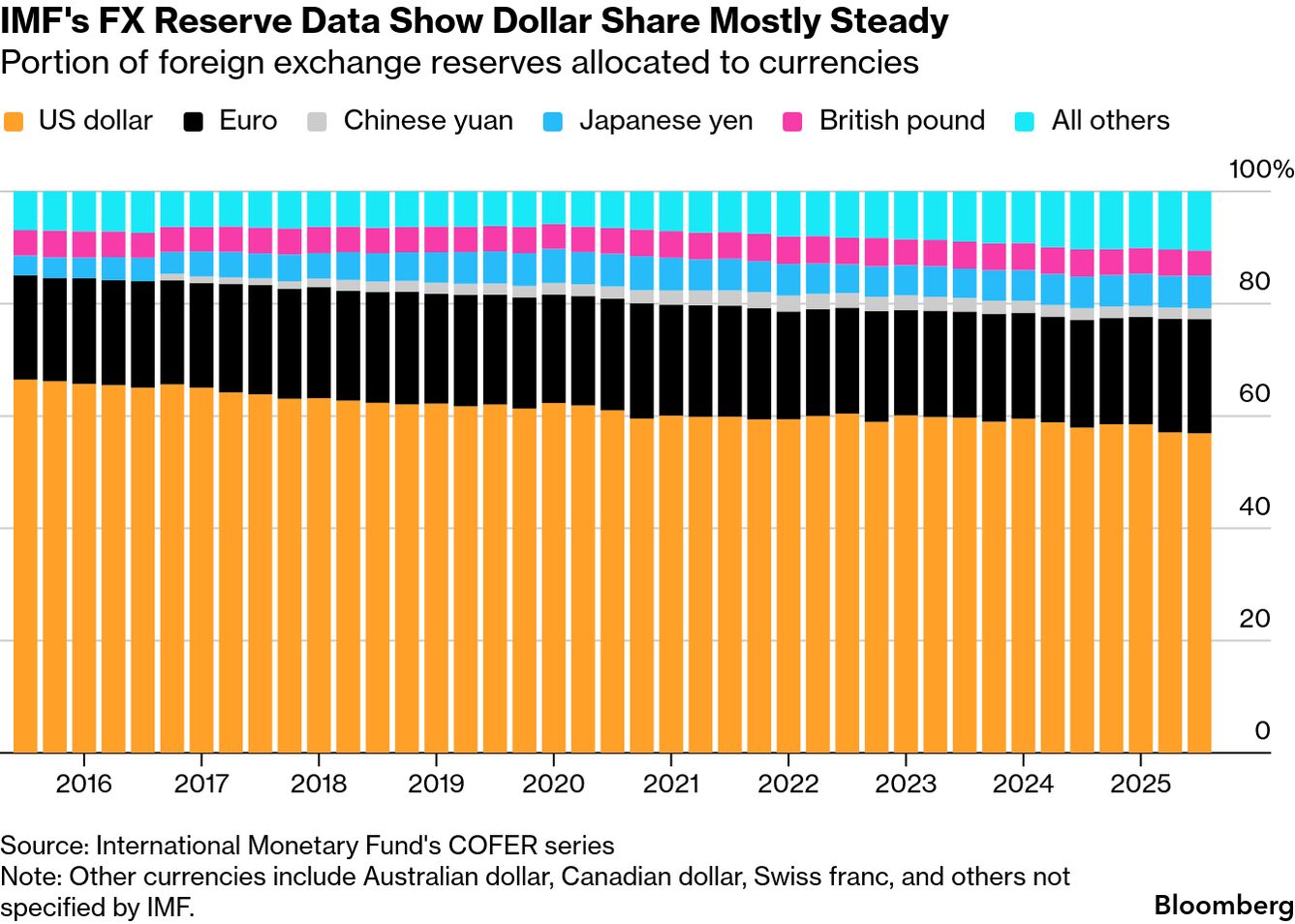
Castelli’s projection, contingent on a range of scenarios, would mark an increase from the average long‑term yuan allocation target of around 6% reported by about 40 central banks last year by UBS Asset Management. The latest IMF data showed the yuan accounted for 1.9% of global central bank reserves as of September 2025.
He joins a chorus of market watchers scrutinizing US President Donald Trump’s policies, weighing their potential for undermining the standing of US assets long seen as reliable portfolio anchors. Such concerns might lift the appeal of non‑US markets, even as the dollar’s dominance and allure are unlikely to fade soon.
“There is an opportunity for China at this point, as demand for US dollar diversification has accelerated by the recent politics of Trump,” he said.
To be sure, the dollar’s dominance in global trade endures, with the latest showing it accounted for more than half of international transactions. Castelli emphasized that the dollar will remain the leading force in global financial markets, with no sign of demise “in the short- or medium-term.”
The decline since last year is more attributable to cyclical factors, driven by interest‑rate differentials, rather than structural shifts, he added.
Still, signs of investor angst over the greenback persist, with central bank gold purchases driving the metal’s to new highs. Trump’s actions — from the seizure of Venezuela’s president to disputes with Europe over Greenland and attacks on the Federal Reserve chairman — have left dollar trading choppy.
Some of the dollar’s strengths, such as liquid markets, a credible central bank, geopolitical influence, and fiscal stability, have been strained by current policies, Castelli noted. If more disruptions emerge, “you will start to see more outflow from the US market,” he said. “That’s where the opportunity comes for China and .”
Meanwhile, Chinese stocks are also set for more inflows this year, backed by loose policy and rising investor interest in AI and high‑value manufacturing, he said.
“We are at the beginning of a new phase of renewed interest by large institutional investors” in China, Castelli said.
Other issues UBS Asset Management is watching in 2026: