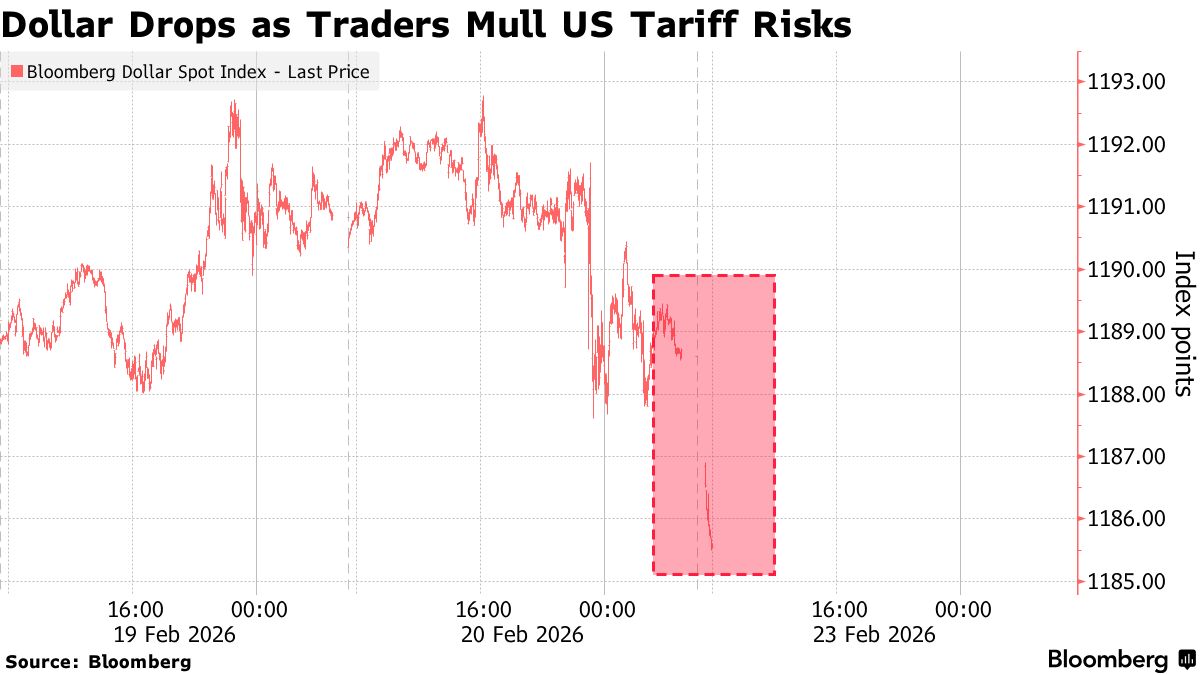
Dollar Falls as Traders Sell US Assets on Trade Policy Risks
The dollar dropped against every major currency as President Donald Trump’s fresh raised concerns about the outlook for the world’s biggest economy.
A Bloomberg gauge of the greenback as much as 0.3%, extending Friday’s decline amid thin trading with Japan’s markets shut for a holiday. The yen, Swiss franc and the Swedish krona led the gains against the dollar after Trump announced a global levy of 15% following a move by the US Supreme Court to strike down the president’s reciprocal tariffs.
Futures on the S&P 500 Index also dropped 0.6% in Asian morning trade on Monday.
“Tariffs as a weapon may have lost a bit of power, but President Trump can still do a fair bit of damage,” said Rodrigo Catril , strategist at National Australia Bank in Sydney. “Trump’s tariff regime is still in place with more uncertainty.”
Trump’s latest tariff threat is clouding the outlook for both the US economy and global trade, with analysts weighing how Washington’s trading partners may respond to the levies. The Bloomberg’s dollar index fell 8.1% last year, its biggest annual drop in eight years, pressured by the Federal Reserve’s policy easing and Trump’s initial sweeping global levies.
Senior US officials Trump’s tariff defeat at the Supreme Court won’t unravel deals negotiated with US partners as they sought to defend the administration’s assertive trade policies. Those deals — which the administration made with partners including China, the European Union, Japan and South Korea — remain in place, US Trade Representative Jamieson Greer said Sunday on CBS’s .
The friction over tariffs spilled over Sunday as Europe’s trade chief said he’ll propose halting ratification of a deal struck with the US, while India postponed talks to finalize an interim trade deal.
“The broad dollar decline likely reflects the fresh injection of policy uncertainty the ruling entails,” Goldman Sachs Group Inc. strategists including Kamakshya Trivedi wrote in a note. “Policy uncertainty is a particularly important channel for the dollar as it can negatively influence investor and business activity.”