China’s Abrupt Yuan Reversal Reveals Anxiety Over War, Oil Shock
The Iranian war is forcing Chinese policymakers into abrupt shifts on the yuan.
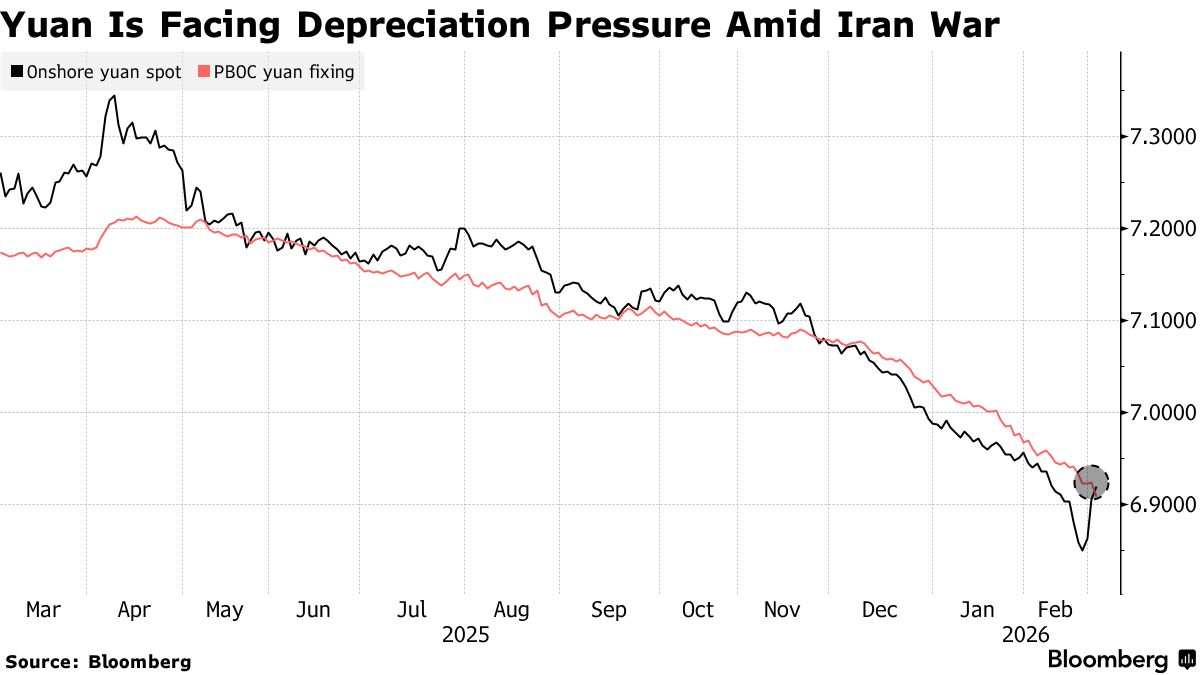
Just days after a derivatives rule that signaled tolerance for yuan weakness, the People’s Bank of China abruptly reversed course, setting its daily reference rate stronger this week despite the dollar’s surge. The rare suddenness of the pivot, defying expectations for further decline, is aimed at cushioning risks from an advancing dollar and spiking oil prices amid Middle East turmoil.
The flip highlights renewed depreciation pressures as global markets reel from higher oil prices and investor retreat from market assets. A strong fixing serves as a confidence signal, countering risks from higher energy costs, shipping , and capital outflows. By anchoring the exchange rate and containing inflation, Beijing also preserves room to keep policy loose for a fragile economy.
“It’s possible that, with potential oil disruptions from the Middle East war, further yuan strengthening is more acceptable than it was last week” to authorities, said Lynn Song , chief Greater China economist at ING Bank NV. “China is the world’s largest oil importer and a stronger yuan could help offset some of the impact from higher oil prices.”
The PBOC set Wednesday’s yuan fixing at 6.9124 per dollar, stronger than last week’s pre‑war close. On Tuesday, a 0.2% advance marked the biggest gain since August. The fixing sets the yuan’s trading band, allowing it to move up to 2% on either side.
The offshore yuan has fallen about 0.9% against the dollar in three straight sessions this week, retreating from last week’s rapid climb to a 35‑month high that had prompted PBOC over the pace of gains.
The equity market may have been a secondary factor in the stronger fixing, with the CSI 300 Index down about 2% this week after two straight weeks of gains. Rather than compounding losses across both foreign exchange and equities, “stabilizing the FX side could help blunt the pain,” Song said.
Sentiment in Chinese assets has been dented as the nation faces the brunt of energy-trade disruptions and to cheaper oil. China purchases about 80% of Iran’s crude exports, accounting for about 13% of its total oil imports, according to a report from Lazard Geopolitical Advisory.
“China’s reliance on imported crude, especially given nearly half of its crude oil imports move through the Strait of Hormuz, exacerbates its growth impact,” the note said, warning that further oil price increases could reduce growth and drive a comparable rise in inflation.
The PBOC’s support for the yuan this week comes alongside broader pushback against dollar strength in Asia. This week, the central banks of Indonesia and India in foreign‑exchange markets to support their currencies, while policymakers in and South Korea voiced concern over exchange‑rate moves.
“During the global risk-off mood, the PBOC may wish to insert some influence of yuan stability to ease market nerves,” which aligns with China’s goal of elevating the currency’s global role, said Xiaojia Zhi , economist at Credit Agricole CIB in Hong Kong.
Meanwhile, the annual session of China’s National People’s Congress, opening this week, may offer markets a confidence boost beyond the yuan fixing.
“China’s NPC will serve as an opportunity to calm market concerns arising from the situation in Iran,” Kiyong Seong , strategist at Societe Generale, wrote in a note. While markets remain wary of sustained oil price strength, Seong noted that “ultimately, domestic factors are likely to dominate over geopolitical risks.”