Euro’s Slide Shows How Energy Shock Is Deepest Vulnerability
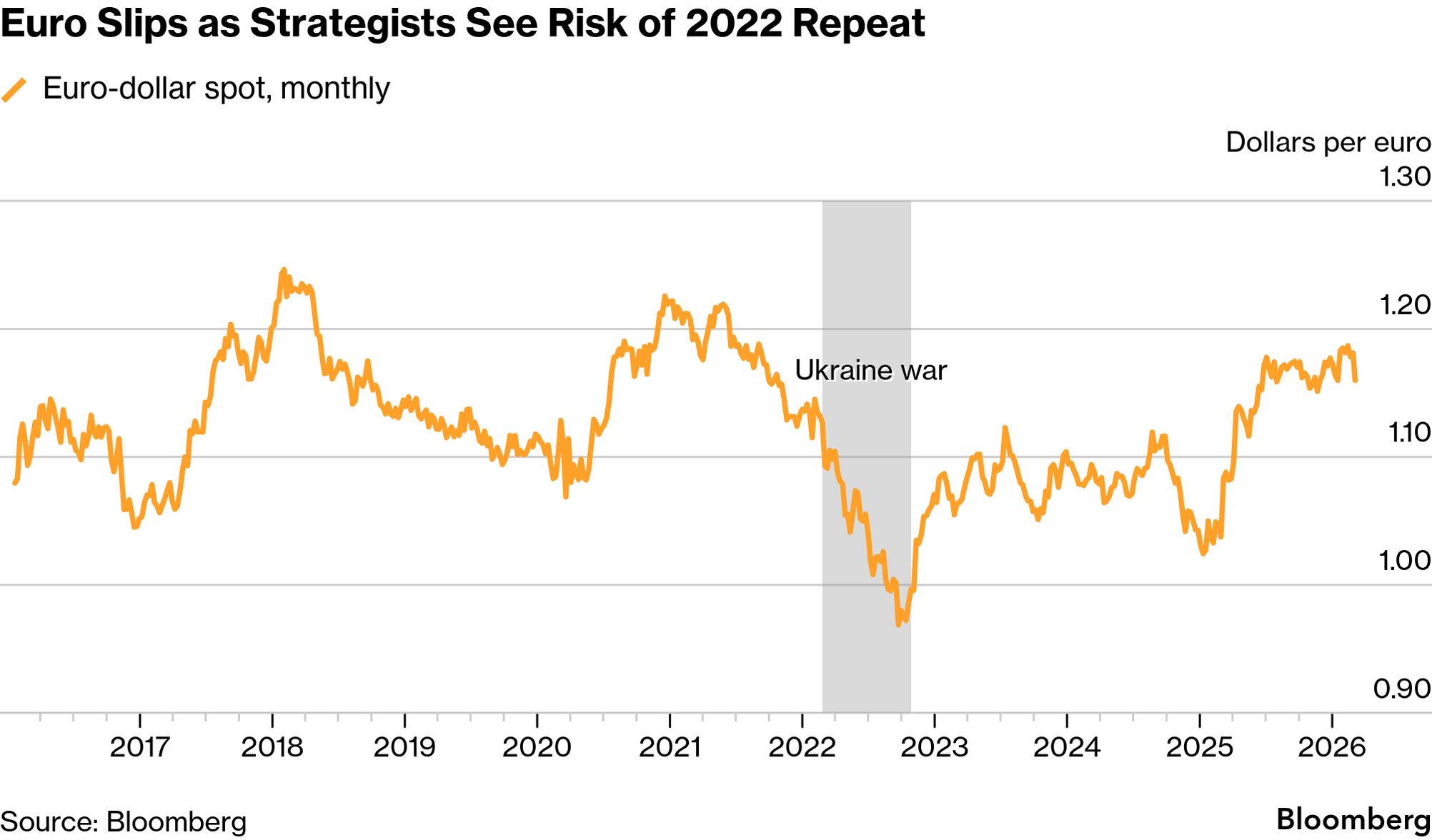
The euro is sliding as a surge in oil and natural gas prices calls attention to Europe’s vulnerability: when energy gets expensive, the region’s trade balance deteriorates and the currency tends to reflect the pain.
The currency has dropped roughly 2% against the dollar this week as war in the Middle East sent oil up more than 15% and briefly doubled natural gas prices.
Europe’s dependence on imported energy means higher commodity prices hit growth and purchasing power more directly than in the US, the world’s biggest oil producer. It’s this dynamic that helped drag the euro below parity to the dollar during the 2022 energy crisis.
Chris Turner , head of foreign-exchange strategy at ING Bank NV., said the duration of the energy shock was “the far more important theme” for the euro than the broader hunt for safe havens, and would determine whether it drops to around $1.10-$1.12 or finds support near $1.15.
The reaction to Russia’s invasion of Ukraine in 2022 shows the scale of the euro’s sensitivity to an energy shock, Barclays strategists led by Themistoklis Fiotakis wrote. Based on that precedent, for every 10% rise in oil, the dollar typically gains 0.5%-1%, while for a similar move in natural gas, the euro drops about 0.25%.
The moves this week fall well within that range and buying the euro at this point therefore “requires a high degree of conviction on de-escalation and may thus not offer good risk-reward,” they added.
What happens next in currency markets is likely to depend on how the conflict develops. For Goldman Sachs Group Inc. analysts, a critical question is whether investors stop hedging against an extreme outcome even as the impact of the energy price hike hurts economies through higher inflation and lower growth.
“Any clear signs that the market is compartmentalizing the risk shock from the energy shock would be a key differentiator for relative FX performance,” strategists including Stuart Jenkins wrote.
Asian currencies face an additional layer of vulnerability because of the dependence of regional economies on fuel shipments through the Strait of Hormuz, which has been effectively closed by the war. A Bloomberg gauge of the dollar has strengthened 1.4% this week and is headed for its biggest weekly gain since November 2024. Meanwhile, a similar gauge for Asia’s currencies has weakened 0.9%.
Another factor driving currencies is the shift in market expectations for interest rates as energy prices climb. Goldman notes that the biggest moves have come in economies where central banks were poised to cut rates this year – in particular the Bank of England, which helps explain sterling’s gains against the euro this week.
By contrast, central banks that were expected to hike interest rates — in Japan, Australia and New Zealand — have seen more muted moves in yields on shorter-dated bonds.
The uneven impact is creating a clear playbook. Standard Bank’s Steven Barrow recommends short euro positions against both the dollar and the Australian dollar, arguing energy prices won’t ease soon. Fiotakis at Barclays draws the same conclusion: currencies with solid terms-of-trade such as the Australian dollar should benefit alongside proven havens like the Swiss franc, while European currencies will remain under pressure.
Euro’s Problem Isn’t Haven Flows, It’s Energy Math: Trader Talk