Euro Options Turn Most Bearish Since 2022 on Fear of Long War
Traders have turned the most pessimistic on the euro since Russia invaded Ukraine four years ago as the war in the Middle East drags on, sending energy prices soaring and threatening Europe’s economy.
In the options market, so-called one-week risk reversals show bearish sentiment on the common currency is now at levels seen after the 2022 invasion, at the start of the Covid-19 pandemic and during elections in the US and France that stoked geopolitical uncertainty. The euro dropped earlier on Monday to $1.1507, its weakest versus the dollar in nearly four months.
Oil above $100 a barrel is highlighting the structural weak spot that has haunted the euro for decades: when energy costs spike, the trade balance deteriorates and the currency takes a hit. Traders are starting to ask whether this conflict has the same potential to send the euro below parity versus the dollar — as happened in 2022.
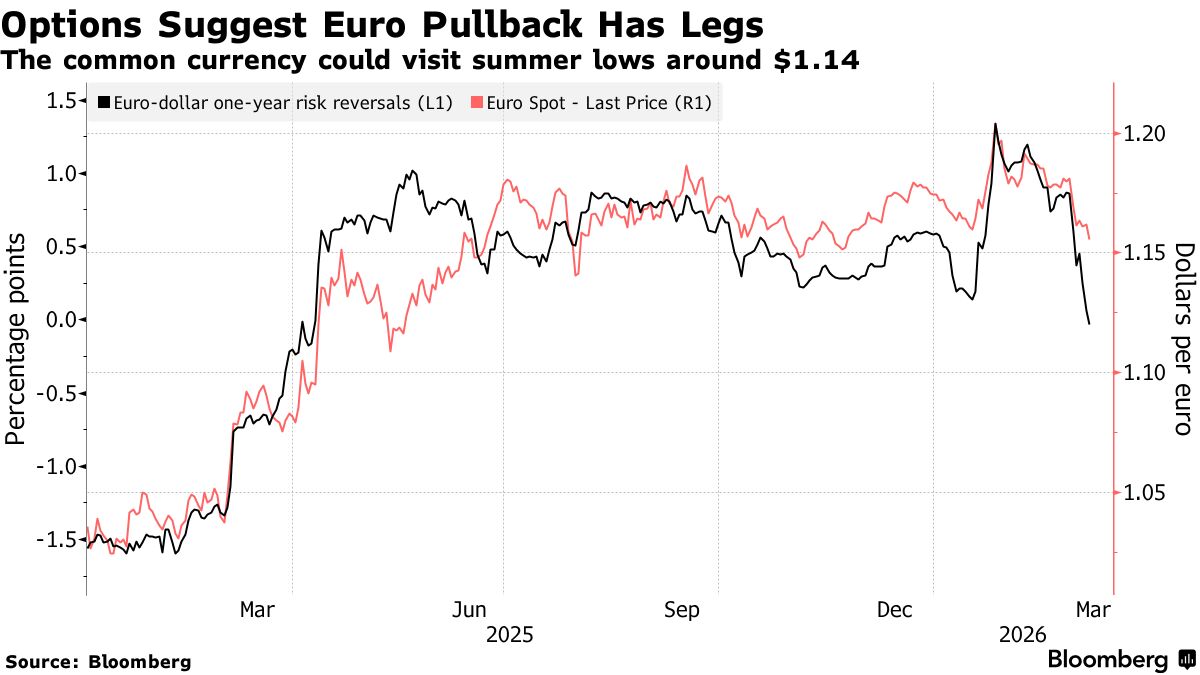
Longer-dated positioning tells the same story. One-year risk reversals have flipped bearish for the first time since April, unwinding the positive shift that followed Germany’s historic decision to ratchet up spending on defense and infrastructure. Optimism on the euro that built up over months has been erased in days, while data from the Commodity Futures Trading Commission show that leveraged funds are also turning bearish the common currency.
Euro volumes are running at 3.5 times the recent average for this time of day, with 71% of today’s options activity betting on a stronger dollar, data from the Depository Trust & Clearing Corporation show.
The currency weakness comes even as the market on European Central Bank interest-rate hikes — suggesting traders fear a toxic combination of soaring inflation from higher energy prices and slower economic growth. Swaps imply two full 25-basis-point hikes by year-end, compared with one on Friday.