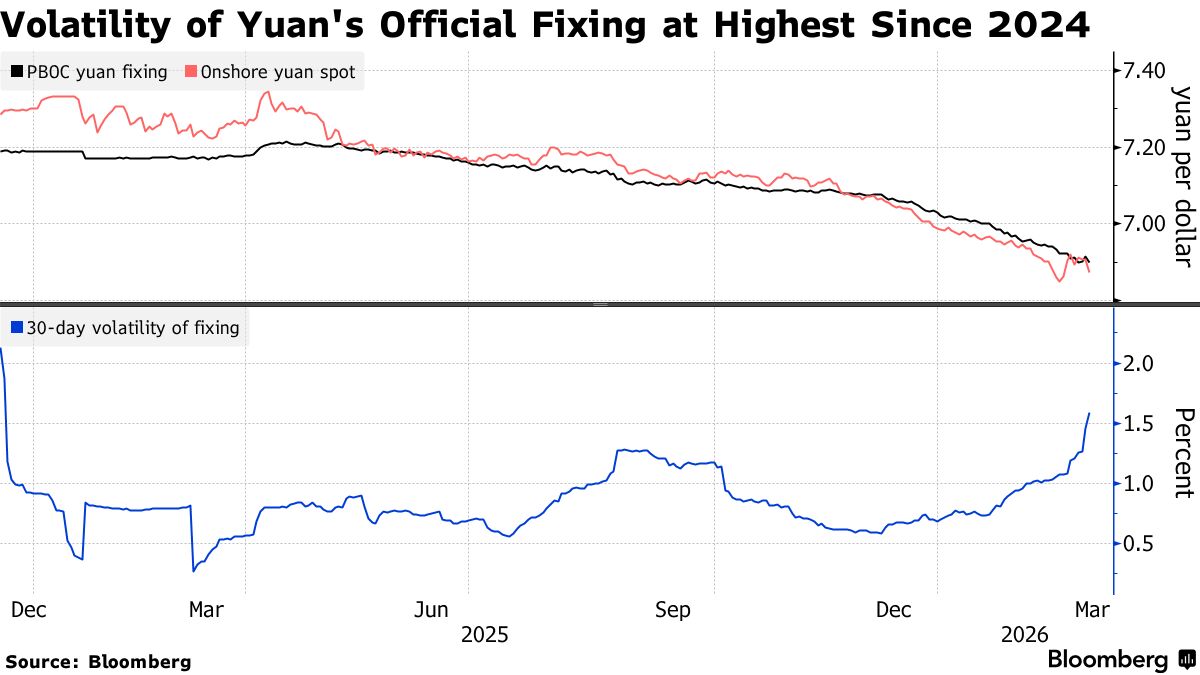
PBOC Employs Volatile Yuan Fixing to Manage Iran War Fallout
China’s central bank is signaling an increased tolerance for yuan flexibility, a sign of confidence it can insulate the currency from market turmoil triggered by the Iran war.
The 30-day volatility of the yuan’s daily reference rate set by the People’s Bank of China climbed to its highest since December 2024 this week, according to data compiled by Bloomberg.
Increased volatility in the daily fixing — the midpoint that limits the yuan’s onshore moves to a 2% band — signals that China is encouraging two-way fluctuations rather than backing a single direction for the currency.
“The PBOC is now comfortable with allowing markets to determine the yuan’s direction at this point,” said Fiona Lim , strategist at Maybank. “That would inevitably introduce some volatility in the fix.”
“It is harder for FX bets to snowball in either direction in this environment,” she said, citing the fluidity of the Iran war.
After touching its strongest level in nearly three years in late February, the yuan has shifted into rangebound territory, pivoting from a one-way rally, as markets digest the latest geopolitical shocks.
It slipped around 0.1% this month amid the Middle East war, posting smaller losses than other Asian currencies, thanks to policy support as well as the nation’s robust .
The PBOC set the yuan fixing at 6.8917 per dollar on Wednesday, its strongest level since 2023 . The yuan traded around the 6.87 level. Beyond daily fixes, Beijing is signaling a broader commitment to stability.
PBOC Governor Pan Gongsheng last week that China is not seeking a yuan devaluation to gain a trade advantage, a move intended to quell speculation of an opportunistic yuan slide as the dollar strengthens. Analysts expect yuan sentiment to hold up ahead of President Donald Trump’s visit to Beijing later this month, as policymakers prioritize a stable currency backdrop to smooth diplomatic discussions.
The yuan remains a relative haven on the back of resilience in China’s fundamentals, said Eddie Cheung , a strategist at Credit Agricole CIB.
With the National People’s Congress still ongoing and a meeting between Trump and his Chinese counterpart Xi Jinping expected at the end of the month, “we don’t see any reason to rock the boat at this time,” he said.