Asia’s Worst Currency May Extend Fall on Exposure to Oil Shock
A historic surge in oil prices is exposing the fragility of import-dependent Thailand, compounding pressure on an already weakening currency and raising the risk of capital flight, analysts say.
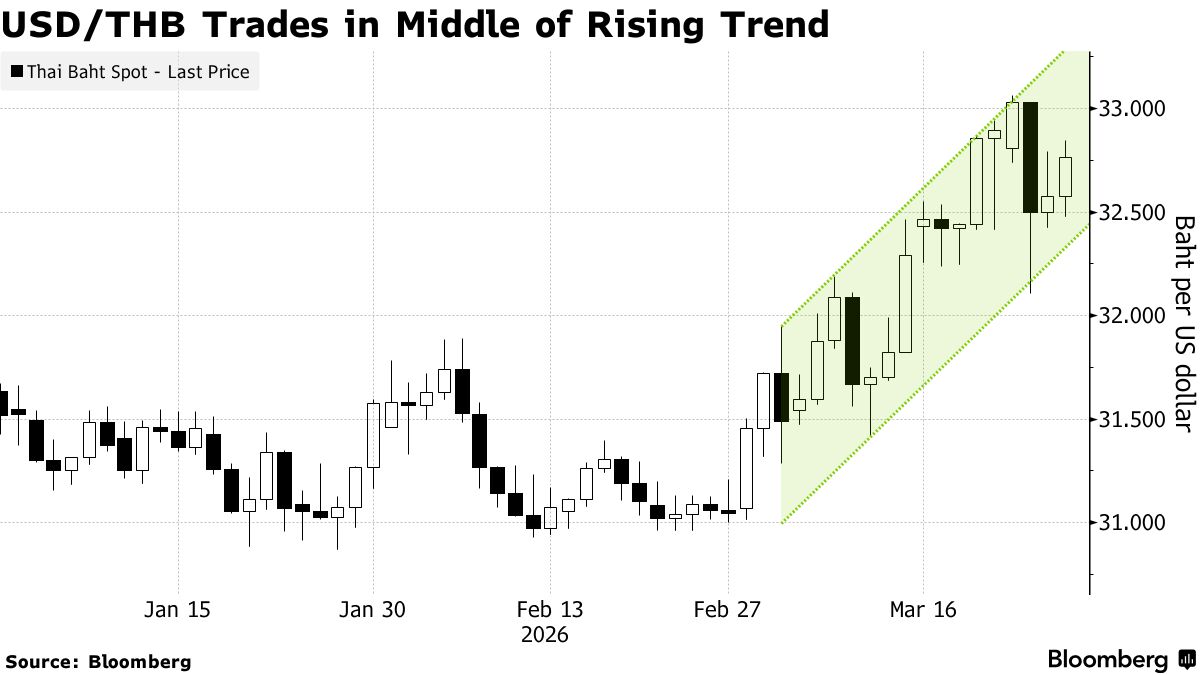
The baht has dropped more than 5% this month, the worst performance among Asian peers. Strategists at see it weakening a further 2% from its current level of 32.8 per dollar by midyear, with rising energy import costs and seasonal dividend repatriation likely to weigh on the currency.
The slide underscores how quickly sentiment in emerging Asian currencies can turn. After a strong performance late last year, the baht has come under pressure from a more than 40% surge in oil prices in March, with Thailand especially at risk due to its heavy reliance on imported crude. That dependence leaves the currency exposed to further commodity swings and capital outflows in the months ahead.
The oil price shock may drag on the nation’s finances and growth, said Jeffrey Zhang , a strategist at Credit Agricole CIB, who sees the currency at 33 per dollar by year-end. “We continue to see room for USD/THB to move higher, while likely at a less rapid pace compared to that in March.”
Higher global jet fuel prices will adversely affect Thailand’s inbound tourism, according to Kobsidthi Silpachai , head of capital market research at Kasikornbank. Thailand’s southern resort hubs have already seen 20% of hotel bookings canceled, while a prolonged US-Iran conflict may push foreign arrivals to a low, raising the risk of an economic contraction.
Still, there are tentative signs the baht may stabilize if global risk sentiment improves, including any de-escalation in geopolitical tensions. While the Bank of Thailand has scope to smooth volatility, it is unlikely to aggressively defend the currency.
“In the short-term, we expect dollar-baht to retrace moderately lower,” said Audrey Ong , a strategist at Barclays Bank Plc, forecasting the currency to be little changed by year-end. “Given relatively rich baht valuations, we doubt the BOT would lean actively against further baht adjustments beyond managing excessive FX volatility.”
Seasonality is unfavorable during the main corporate dividend payment period, with the baht weakening about 1.3% on average in the three months to June 30 for the past decade, according to data compiled by Bloomberg. This year, companies are expected to pay about 151 billion baht ($4.6 billion) to foreign investors, lifting demand for dollars in April and May, according to Kasikornbank.
Capital outflows are also adding to pressure on the baht. Global funds have sold a net $788 million of Thai bonds this month, the most in over a year, according to Thai Bond Market Association data. Meanwhile, the nation’s equities have seen $1.2 billion in outflows over the same period, the largest since February 2023, based on Stock Exchange of Thailand figures.
“Perceptions that the government is not handling the current economic situation effectively are adding to investor concerns,” said Jitipol Puksamatanan , head of investment strategy at Finansia Syrus Securities.