Korea’s AI Impact Sparks Pressure Across Government Bond Market
Investor fervor for artificial intelligence that has driven South Korea’s stock market to the top of global rankings is taking a toll on another market: government bonds.
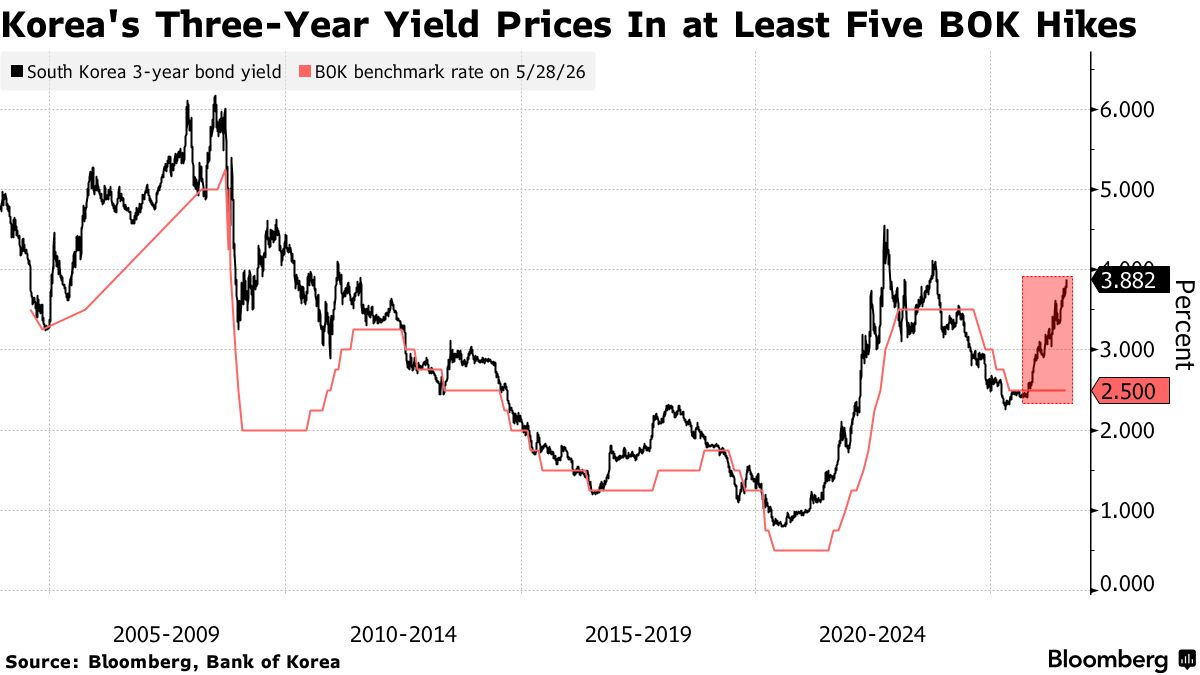
The nation’s government bonds have lost 7.5% this year in local-currency terms, the worst performance among 44 markets tracked by Bloomberg. The benchmark three-year yield rose to about 3.9% Friday, its highest level since 2023.
At the heart of the rout lies a growth story too strong for bonds to bear. A surge in AI investment and semiconductor demand has reignited Korea’s economy, lifted prices, and fueled bets the central bank will need to raise rates to rein in momentum.
Korea isn’t alone in facing bond , as strong government spending and higher energy costs from the Iran war heighten inflationary pressures worldwide. But the squeeze is sharper in Asia’s semiconductor hub, where and have drawn investor capital toward equities, as well as greater volatility. Inflation had already been stoked by high apartment prices , while the won’s tumble drives fears of rising import costs and triggers further Bank of Korea rate hikes.
“It’s a vicious cycle feeding on itself,” said Cho Yong-gu , a fixed-income strategist at Shinyoung Securities, referring to bond market conditions. “There doesn’t seem to be any clear way out at the moment.”
Yields are climbing in anticipation of the BOK’s upcoming tightening cycle. The swaps market is pricing in at least three hikes this year, taking the policy rate to 3.25% from 2.5%.
Cho expects the nation’s three- and 10-year yields to reach up to 4% and 4.4% this year.
The chip sector’s boom and the roughly 80% jump have helped to lift the BOK’s growth forecast for this year to 2.6% from 2%. Inflation adds to the case for rate increases, with the 2.5% core inflation in May showing pressures spreading beyond energy. The data supports the hawkish tilt under new BOK Governor Shin Hyun Song .
After the latest policy meeting, which struck a distinctly hawkish tone, “one can’t help but wonder whether the bond market has simply been abandoned,” Cho said.
The government last week pledged to monitor the bond market and respond promptly to excessive volatility, officials from the finance ministry and BOK said in a statement.
Supply Risks
Fiscal spending and the additional bond supply it may require will be closely watched as tax coffers swell from chip sales under the current left-leaning government. Officials in March there would be to fund a supplementary budget, but talk of yet another extra budget has left traders on edge.
Any large-scale fiscal package in the upcoming 2027 budget proposal may also add upside risk to policy rates, said Lim Jae-kyun , a fixed-income analyst at KB Securities, who projects 10-year yields rising to 4.4% if the Bank of Korea lifts the policy rate to 3.5%.
Meanwhile, the rapid rise in yields has also spurred unusually hands-on efforts by policymakers. Starting last month, some of the finance ministry’s treasury bond officials have been bond dealers and asset managers to gauge sentiment and positioning.
Authorities have also set up a private KakaoTalk chat room with market participants and researchers to monitor conditions in real time.
In a more direct effort to ease volatility, the government cut planned June bond sales by about 21% from May, trimming mainly longer tenors.
Still, current trends will likely linger near-term, according to Woo Hyeyoung , a fixed-income analyst at eBest Investment & Securities. “The directional trend in rates will remain biased to the upside for the time being in the second half of the year,” she said.
This week’s main economic events: