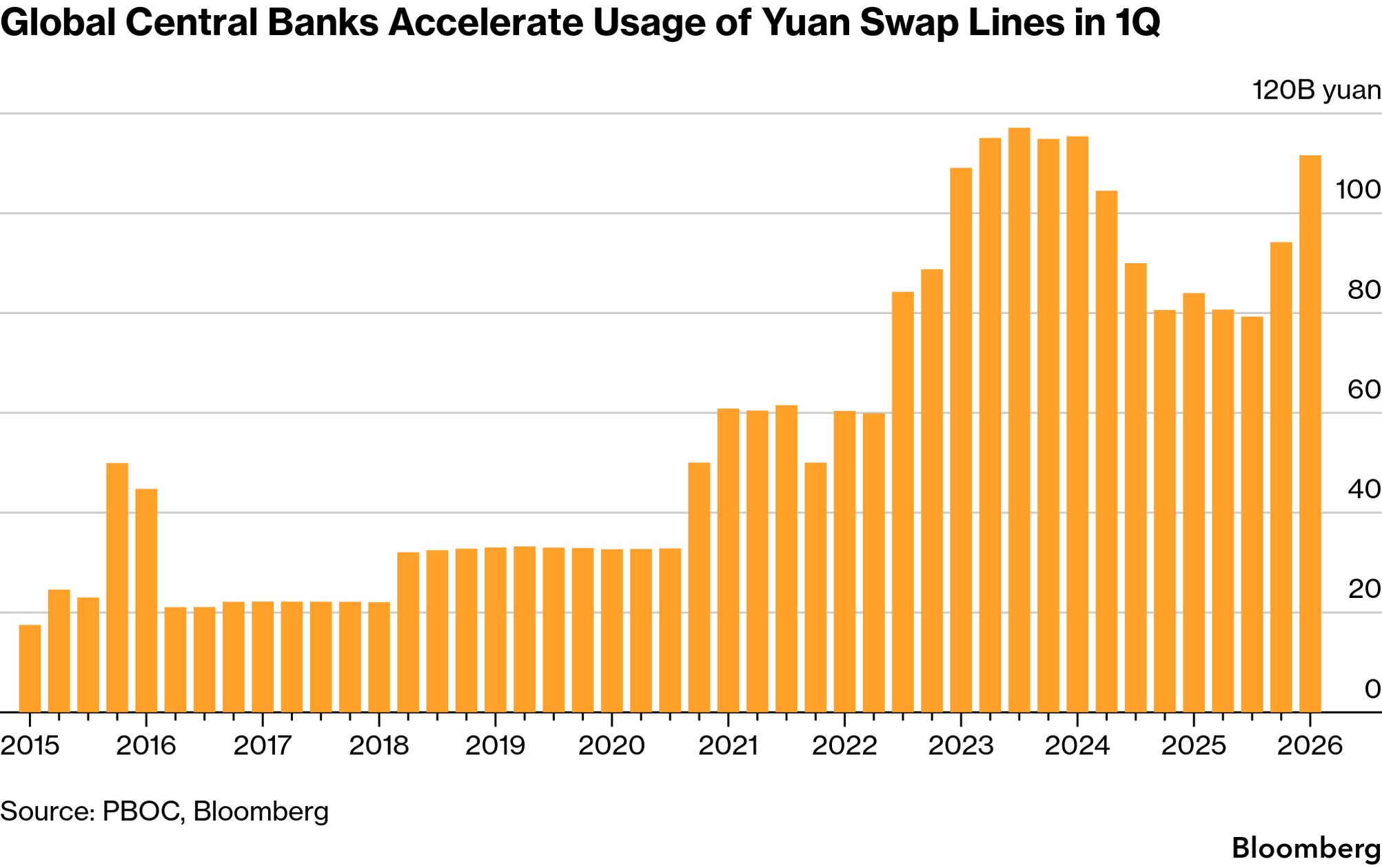
Central Banks Tap Most Yuan Swap Lines With PBOC in Two Years
Global central banks’ use of the People’s Bank of China ’s swap lines reached a two‑year high in the first quarter, underscoring rising international demand for the Chinese currency.
By the end of March, central banks worldwide had drawn a total of 111.6 billion yuan ($16.4 billion) from the PBOC’s foreign‑exchange swap lines, the highest level since March 2024, according to the Chinese central bank’s quarterly report released late Monday. The 17.4 billion yuan increase from the previous three-month period marked the steepest quarter‑on‑quarter rise since 2023, Bloomberg calculations show.
China’s swap line is a key tool for supplying yuan to the global financial system, allowing local institutions to access liquidity through their own central banks to support trade and investment. The latest increase highlights China’s drive for yuan internationalization and countries’ increasing openness to reduce reliance on the dollar.
“The onshore yuan has been doing quite well in recent months and was one of the top performers post-Iran war as well, which may have attracted increased confidence and interest from foreign countries,” Lynn Song , chief Greater China economist at ING Bank NV, said. “More usage of the swap lines suggests positive developments on the renminbi internationalization, though this remains a long-term work in progress.”
The onshore yuan has gained about 2.9% against the dollar this year, even as Iran war tensions boost demand for haven assets, with more international transactions settled in China’s currency.
While the dollar retained its dominant role in trade in March, the yuan rose one spot to become the fifth most active currency for global payments by value, accounting for 3.10%, according to from financial messaging service Swift, or the Society for Worldwide Interbank Financial Telecommunication . China’s cross-border interbank payment system, known as CIPS, also registered a single-day transaction record of 1.22 trillion yuan, Shanghai Securities News reported in early April.
Growing demand for yuan liquidity amid geopolitical tensions, including the Iran war, has been evident, while dollar funding costs have also risen, said Stephen Chiu , chief Asia FX and rates strategist at Bloomberg Intelligence. “Demand could come from China allies’ central banks, which are seeking liquidity because of the oil price shock,” he added.
As of the end of 2025, China had signed currency swap lines with 32 countries and regions, totaling 4.52 trillion yuan, according to PBOC data.
Meanwhile, markets are also monitoring whether the US will extend its currency swap lines. Earlier this month, the United Arab Emirates’ foreign trade minister the nation was in talks with Washington on a swap agreement, aiming to join the small group of countries with access to Federal Reserve liquidity lines.