Taiwan’s ‘Big Boss’ Central Bank Is Stamping Out Currency Swings
Taiwan’s central bank is extending its reach ever deeper into foreign-exchange markets, seeking to ensure currency stability as the artificial intelligence boom intensifies a divide between the island’s tech sector and the rest of the .
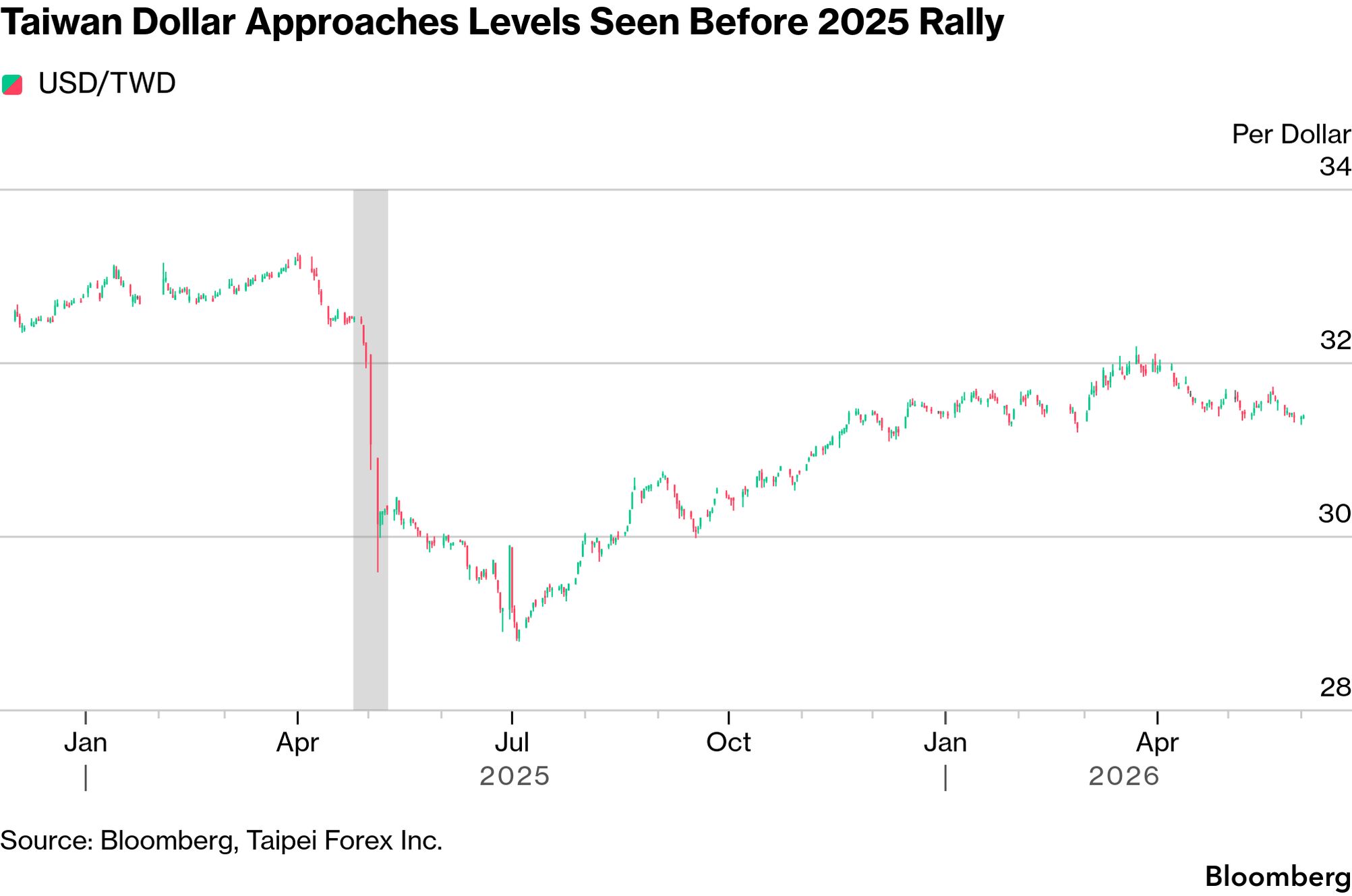
The monetary authority known as the Central Bank of the Republic of China, or CBC, has been on a mission to stamp out volatility since a surge in the Taiwan dollar erupted almost from nowhere last year, sparking the most violent swings since the 1980s.
It has been instructing exporters to sell US dollars at times of currency weakness while guiding life insurers to buy the greenback when the Taiwan dollar strengthens, according to a dozen traders, regulators and economists interviewed by Bloomberg. It also keeps close tabs on trading activity via dedicated phone lines and has sometimes even sought to influence market hours and media reports on the subject, the people said.
The urgency behind the CBC’s hands-on currency management stems from its economic dilemma. While the island’s tech sector thrives on global AI demand, industrial manufacturers are feeling the squeeze, needing a weaker currency to remain competitive against regional rivals. But the CBC also faces criticism that the Taiwan dollar is undervalued, occasionally drawing the ire of the US Treasury Department. As Taiwan’s booming economy fuels a surging trade surplus, the central bank must tread carefully to avoid drawing further unwanted scrutiny from Washington.
And the stakes have never been higher for the CBC, also nicknamed “Lao Da,” or the “Big Boss,” by foreign-exchange traders due to its presence in the market. Not only does the domestic economy depend on its policy balancing act, but so do billions of dollars of global money invested in the local stock market, and even more Taiwanese funds parked in financial assets abroad. Adding to the complexity is the geopolitical standing of the island as it faces scrutiny from both US President Donald Trump and his Chinese counterpart Xi Jinping .
Taiwan’s ascent as a semiconductor powerhouse has drawn waves of global capital, helping drive a doubling of the local over the past year. But this tech-led prosperity requires a complex balancing maneuver. On one side, exporters like attract vast inflows and also generate hundreds of billions in foreign sales, raising the threat of currency spikes when those earnings are brought home.
On the other, local life insurers, which provide a crucial outflow for that capital, hold the majority of their wealth abroad, leaving them with the power to rattle global bond markets if they suddenly exit these investments.
“The whole AI and chip frenzy complicates everything: it creates unstoppable upward pressure on the Taiwan dollar that pure management can’t fully contain,” said Alicia Garcia Herrero , chief economist for Asia-Pacific at Natixis. “Taiwan’s ‘controlled stability’ approach has served it well for export-led growth, but it builds risks, especially currency mismatches for life insurers and delayed rebalancing.”
The CBC’s increased market vigilance means traders in Taipei are proactively reporting sizable currency orders to the Lao Da on a dedicated phone line present on every bank trading desk, before authorities question them on the size and purpose of the deal or even the name of the customer, people familiar with the matter said.
Some traders choose to report every single deal to the CBC since the episode last year, in the absence of clear guidelines on what the central bank considers an excessively large order, the people said. That’s on top of their years-long practice of reporting a summary of trading activity at the end of the day. The people spoke on the condition of anonymity as they are not authorized to speak publicly.
“Foreign investors, exporters and importers can all trade freely, and our communication with them mainly focus on spreading out the deals, avoiding large and concentrated deals,” the CBC said in response to questions from Bloomberg. “The central bank cannot dictate the direction of the exchange rate, which is determined by market forces. When supply and demand become significantly imbalanced, the central bank will step in to smooth market fluctuations.”
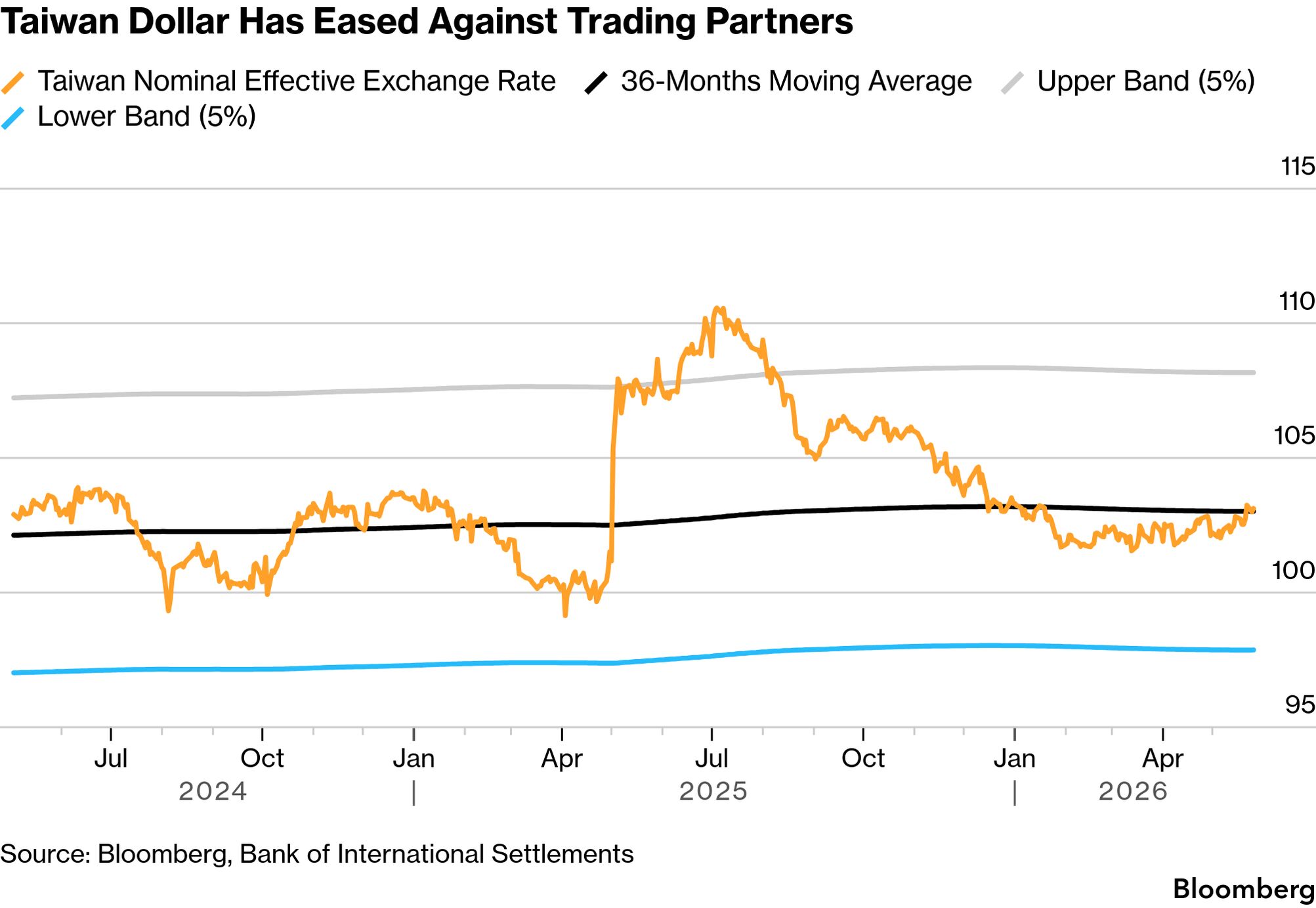
The CBC’s efforts have been rewarded. It has successfully reeled the currency back in after its volatility overshot its bounds last year. In 2025, the Taiwan dollar’s nominal effective exchange rate surged to the highest in decades and breached the 5% threshold around its 36-month moving average, a the central bank uses to measure stability. This year, tighter management has kept the currency within those parameters.
Beyond its stealth presence, the CBC has also become a gatekeeper against the wall of foreign capital chasing Taiwan’s AI-led stock boom. It now requires overseas stock investors to provide proof of orders before the local currency, as the “big boss” wants to make sure they are doing so to buy equities instead of using it as a pretext.
The bank has also asked banks and traders to verify the purpose of currency settlements, ensuring that inflows are strictly tied to real investments.
The challenge for the CBC is that Taiwan’s exporters are expected to evolve into an over $800 billion in 2026 that dictates the island’s economic pulse and the world’s technological future. Led by TSMC, the main chipmaker for Nvidia Corp. and Apple Inc., and electronic giants like Foxconn Technology Co., export orders for Taiwan’s firms soared to a record $743.7 billion in 2025.
When some of these earnings must come home and be converted into the local currency, any sudden, massive flows run the risk of overwhelming the market and threaten a repeat of last year’s rally. That partly explains the sudden and disruptive gain for the currency last year.
The rules of the game have changed. The CBC was seen talking to exporters more directly in the past year. Foreign-exchange traders at banks were alarmed by larger-than-usual orders to sell dollars placed by exporters who hinted that the deal was already signed off or even encouraged by the authorities, according to the people.
Even the trading hours are carefully managed. For at least a few weeks after last May, the CBC asked exporters to sell dollars only after 10 a.m. local time to avoid any abrupt moves in early trade when market liquidity tends to be thin, the people said.
A strong currency is gripping Taiwan’s traditional manufacturing sectors such as plastics, textiles and machinery out of global competitiveness, said Meekita Gupta , an economist from Pantheon Macroeconomics Ltd. “Korea and Japan’s exchange rates are not appreciating as much.”
Taiwan isn’t the only Asian economy that has increased its scrutiny of financial markets. Over in South Korea, officials from the finance ministry’s treasury-bond division have been and asset managers before the start of trading to gauge market sentiment and investor positioning since last month.
To maintain the stability, Taiwanese life insurers act as a vital pressure valve, absorbing the billions generated by tech exports and investing them into a $700 billion overseas portfolio. While this outflow provides a necessary counter-weight to the trade surplus, it also creates a risk: when the currency appreciates, insurers often retreat into a hedging frenzy. By rushing to sell the greenback to protect their asset values, they inadvertently pour fuel on the Taiwan dollar’s gains.
The ripple effect of this behavior was felt beyond Taiwan. In May last year, Taiwan’s insurance companies were said to have sold South Korean won-denominated non-deliverable forwards, helping push the currency lower against the dollar. The won is often treated as a proxy for the Taiwan dollar in the NDF market.
However, a that came into effect this year has taken the pressure off life insurance firms to hedge currency risks. The subsequent unwinding of existing hedges has also increased the demand for dollars, subduing the local currency. While such hedging transactions traditionally require approval from authorities, insurers will only be permitted to conduct such trades when the Taiwan dollar is appreciating, the people said.
Khoon Goh , head of Asia research at Australia & New Zealand Banking Group, said reduced insurer hedging has left the currency more exposed to equity flows.
“Even though Taiwan runs huge trade surpluses, thanks to the strong growth in semiconductor exports, the exporter conversion ratio remains extremely low. So it’s really the foreign equity flows in particular that are a big source of the volatility,” he said.
The Taiwan dollar slumped to the weakest in nearly a year in March when foreign outflows from stocks reached a record high at the height of the Iran war that month. It has pared some of those losses to trade around 31.4 per dollar. The currency is among the best performers in Asia so far this quarter.
The central bank had also blamed the currency’s sudden surge last year on overly strong market expectations .
Around that time, local media outlets received reminders from the CBC, asking them not to mention the expected value of the Taiwan dollar, people familiar with the matter said. The guidance was part of broader efforts by the central bank to curb market expectations for further appreciation and to avoid adding fuel to the currency’s gains. Aside from that, at least two Taiwan banks also stopped publishing research on the local currency without explanation.
While market hype fueled speculation that trade talks would pave the way for a stronger Taiwan dollar, the CBC clarified that the US never demanded an appreciation. The US Treasury’s latest highlighted that Taiwan’s currency interventions have shifted toward two-way activity aimed strictly at smoothing volatility.
The CBC has also tapped its to stabilize the currency, but most of its efforts are through window guidance and the actual interventions remain mild, focused on avoiding outsize volatilities. That’s unlike other major monetary authorities like the Bank of Japan which often let the market move before stepping in.
Yet, the CBC is seeking stabilization, rather than an artificially weak currency. A stable Taiwan dollar is key to curbing imported inflation amid the Middle East conflict, Governor Yang Chin-long said.
“The CBC is storing up future trouble by keeping the Taiwan dollar stable at such a weak level,” said Brad Setser , a senior fellow with the Council on Foreign Relations. It’s “effectively allowing the insurance sector to make a massive bet that the CBC will, if needed, block any significant future appreciation.”