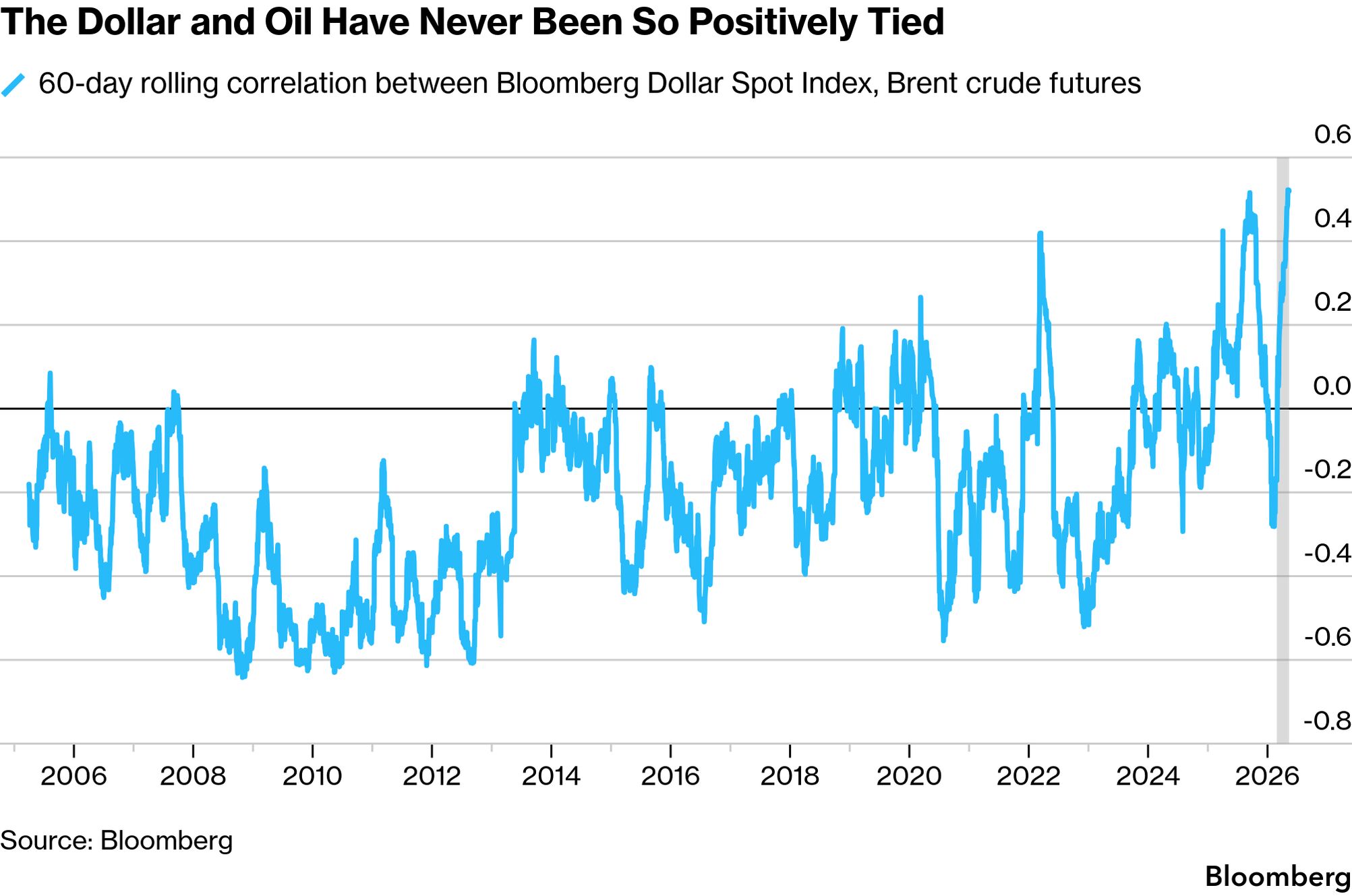
Dollar’s Link to Oil Most Positive Ever Amid Iran Conflict
Eleven weeks into a Middle Eastern conflict that has shuttered a critical shipping channel and sent energy prices soaring, the US dollar’s linkage to oil prices is more positive than ever before.
The correlation between the and Brent crude futures now trades at its highest level on record, going back to when the greenback gauge launched in 2005. Said differently, the extent to which oil and the greenback trade in tandem each day is the strongest in more than two decades.
The positive correlation is historically unusual. Most oil trading is conducted in US dollars — known as the petrodollar system — which means traders might expect a surge in the greenback to ultimately hamper demand for oil. But the Iran conflict has pushed up the prices of both the greenback and oil simultaneously.
Bloomberg’s dollar gauge rose some 0.3% on Thursday, extending gains in New York trading, while Brent crude futures rallied by about the same amount as traders watch the progress of talks between US President Donald Trump and his Chinese counterpart, Xi Jinping.
The price of a barrel of Brent oil has surged about 45% since the US and Israel first launched strikes against Iran at the end of February, leading Iran to effectively shutter transport via the Strait of Hormuz. The International Energy Agency said this week that the market will remain “ ” until October.
Meanwhile, Bloomberg’s dollar gauge has risen nearly 1% as investors consider the US position as the world’s largest oil producer and the fact that the dollar underpins much of the global crude trade. After trading negatively for much of the first quarter, the dollar and oil’s correlation turned positive in early March and has stayed that way since.
“There are periods when macro is the driving force behind market moves and there are intervals, like now, when it’s more about geopolitics, headlines, risk appetite, and momentum,” said Brent Donnelly , president of Spectra Markets. “The narrative is: Oil up/oil down.”
That’s also making it more difficult to trade based off of other fundamental drivers of exchange rates, like interest-rate differentials or growth data, which investors have long considered key to determining currency values.
Read more:
“Barring a sharp fall in equity markets, modest moves in currencies will continue to be driven by the next big move in oil prices and how central banks (including the Fed) react to higher inflation,” Chris Turner , head of foreign exchange strategy at ING Bank NV, wrote this week.