Goldman Says Central Banks Want More Gold for Their Reserves
Central banks are expected to step up gold-buying, helping prices to recover by year-end, according to Goldman Sachs Group Inc.
Purchases are expected to pick up to average 60 tons a month over 2026, analysts Lina Thomas and Daan Struyven said in a note dated May 15. Under a revised framework for estimated accumulation, the 12-month moving average of purchases was 50 tons in March, up from a prior figure of 29.
For central banks, there’s “strong underlying interest in gold, and recent are likely to reinforce diversification,” the analysts said, citing an in-house survey, without giving details.
Gold has struggled since the outbreak of the war in the Middle East, as higher energy costs have raised worldwide inflationary pressures, making central banks less likely to ease policy . With no end to the conflict in sight, global bond markets have sold off, putting pressure on non-yielding gold.
Goldman’s assessment of official-sector activity follows an upbeat report from the , which estimated purchases at 244 tons in the first quarter, up from 208 tons in the prior three months.
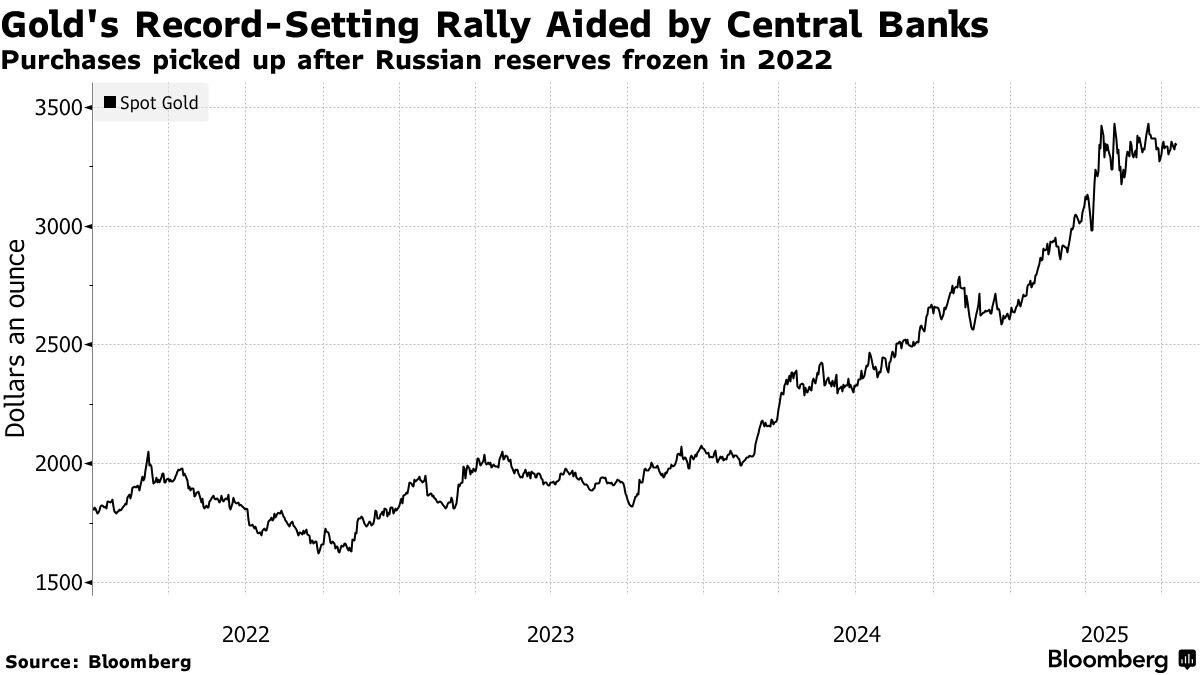
Spot gold traded above $4,545 an ounce on Monday, compared with a record just below $5,600 set in late January. Goldman maintained a bullish target for prices to climb to $5,400 an ounce by the end of this year, following similar recent calls from UBS Group AG and ANZ Group Holdings Ltd .
Still, Goldman was cautious near term. Gold is “a natural source of cash if private investors face liquidity needs — for example, if equity markets sell off amid higher rates and weaker growth expectations,” the analysts said.
Goldman’s methodology for estimating central-bank buying had rested in part on assumptions based on flows seen in UK trade data. It was updated as the figures may “no longer fully reflect” shifts, the analysts said.
Among central banks, the People’s Bank of China bought the most gold in over a year in April, boosting holdings by 260,000 troy ounces . That was the 18th month of additions, matching a streak that began in late 2022.