Hedge Funds Temper Steep RBNZ Rate Rise Bets as Economy Cools

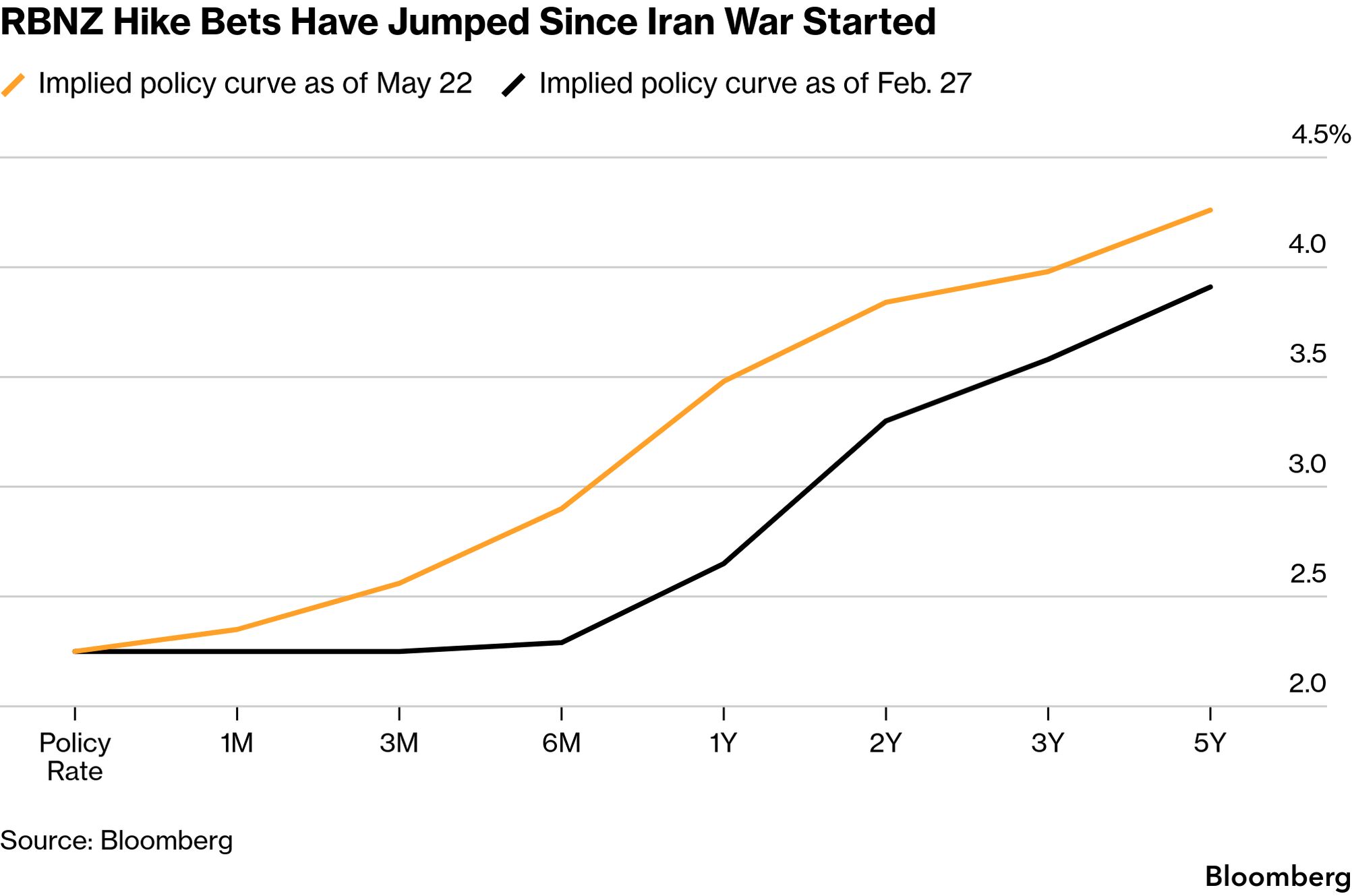
Hedge funds are betting that a weak economic backdrop will force the Reserve Bank of New Zealand to undershoot expectations of five quarter point rate increases priced in the swaps market.
Leveraged funds have begun receiving fixed rates and paying floating in the swaps market — a move that profits if the RBNZ tightens less than currently priced — according to Andrew Walsh, Sydney-based head of Australia and New Zealand rates trading at Citigroup Inc.
These bets point to growing market skepticism on the RBNZ’s ability to aggressively raise rates this year, with the surge in oil prices due to the Iran war already hurting the economy. New Zealand’s consumer confidence has slumped to a three-year low , retail card spending has declined and manufacturing activity is near contraction.
“I view the pricing to be too aggressive,” Mark Elworthy , Sydney-based head of Australia & New Zealand rates trading at Bank of America, said, referring to rate expectations. “It’s likely been amplified by crowded positioning from the broader investment community and a prolonged period of low liquidity.”
The debate comes ahead of the RBNZ’s May 27 meeting, where policymakers are widely expected to leave interest rates unchanged while maintaining a hawkish tone. Governor Anna Breman said last month the RBNZ was “ ready to act decisively ” if it sees inflation pressures building.
“The market expects a pause from the RBNZ this week, but with a sole inflation mandate the market remains nervous of a surprise hike,” Walsh said.
Those market jitters are stemming from the central bank’s recent guidance. The RBNZ held the Official Cash Rate at 2.25% in April but said that any signs of significant second-round inflationary effects or increases in medium-term inflation expectations would require decisive and timely boosts in the OCR.
John Sidawi, a senior portfolio manager at Federated Hermes in Pittsburgh, said one or two RBNZ hikes may be justified, but current market pricing appears excessive. He sees long-dated New Zealand government bonds as among the most attractive trades should the US and Iran reach a deal that eases oil prices and undermines the hawkish outlook currently embedded in markets.
New Zealand’s benchmark 10-year yields have risen about 37 basis points since the US and Israel launched their attacks on Iran at the end of February to be among the highest in developed markets.
Bank of America economists believe there is good reason to expect the RBNZ to leave interest rates unchanged for all of 2026.
“There is a compelling case for the RBNZ to remain on hold through 2026,” said Nick Stenner , the bank’s head of Australia and New Zealand economics. Inflation is being driven largely by supply-side factors beyond the central bank’s control, while medium-term inflation expectations remain anchored, spare capacity is increasing and financial conditions are already restrictive, he said.
This week’s main economic events: