Indonesia Faces Crisis of Confidence as Markets Decode Prabowo
Indonesia spent much of this week confronting a question that might have seemed unthinkable a few short years ago: what happens when investors stop believing in Southeast Asia’s largest economy?
The answer played out across trading screens around the world and at government offices in Jakarta. Stocks sank to their lowest levels since the pandemic, the rupiah breached the psychologically important 18,000-per-dollar level for the first time and rumors swirled that Finance Minister Purbaya Yudhi Sadewa was on the way out.
Read more:
By the end of the week, Purbaya and senior government officials were on the defensive. “I’m not the type to quit,” Purbaya said at a state budget briefing Friday. He was at the country’s fiscal position, saying the nation’s assets remain stable and inflows healthy.
“Optimism about the Indonesian economy remains strong,” he said. “Why are people saying the economy is heading toward a recession when economic stimulus is sufficient, liquidity is sufficient, and credit growth is also sufficient? Don’t be swayed by a single news report.”
But the damage was largely done. Investors increasingly see Indonesia as a market where policy uncertainty, political intervention and execution risks are beginning to outweigh one of the developing world’s most compelling long-term growth stories — a sentiment that’s been growing since President Prabowo Subianto took office less than two years ago.
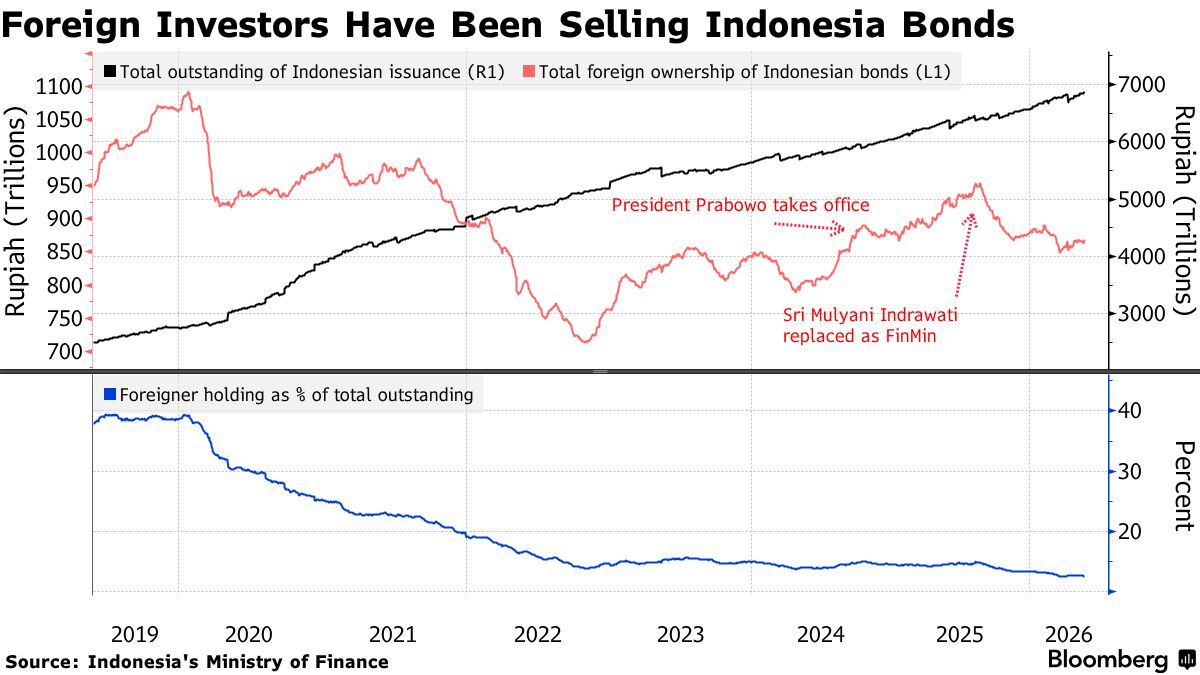
Investors are “concerned about the direction of policymaking in Indonesia,” Jason Tuvey , deputy chief emerging markets economist of Capital Economics, said. “Especially so, after widespread protests in the middle of last year led to the sacking of respected finance minister Sri Mulyani Indrawati . Since then, the government has adopted increasingly populist and interventionist policies.”
Speculation over Purbaya’s departure wasn’t the only thing sending markets into a tailspin. There were also mounting concerns over the government’s economic management, confusion regarding new commodity export rules and a involving Prabowo’s flagship $15 billion free meals program.
Read more:
driven by the conflict in the Middle East are also adding to pressure on Indonesia’s economy, forcing the government to spend more on fuel subsidies while facing higher import costs for crude oil and LPG. Like several of its Southeast Asian neighbors, Indonesia imports a significant share of its crude from the region, making it particularly vulnerable to supply disruptions and price shocks.
Indonesia’s benchmark stock index has now fallen more than 35% this year, making it the worst-performing major equity market tracked by Bloomberg. The rupiah has dropped roughly 14% since Prabowo took office and is Asia’s weakest currency in 2026. Foreign investors have cut holdings of Indonesian sovereign bonds by about 86 trillion rupiah ($4.8 billion) since last August.
The plunging currency is also making the repayment of US dollar-denominated debt a daunting prospect.
According to data compiled by Bloomberg, the government and companies in Indonesia have some $12.6 billion of foreign currency bonds due in 2027 and $11.3 billion to $16.3 billion in each of the four years thereafter. The government has issued more than $11 billion in foreign-currency notes so far this year, the data show.
Putting additional downward pressure on the rupiah, according to Peter Mumford , who heads the Southeast Asia practice of Eurasia Group, is Bank Indonesia’s expanded growth mandate. The parliament on Thursday passed that grants it power to conduct performance evaluations of Bank Indonesia, the Financial Services Authority and the Deposit Insurance Agency.
That “risks exacerbating concerns about institutional independence,” Mumford said.
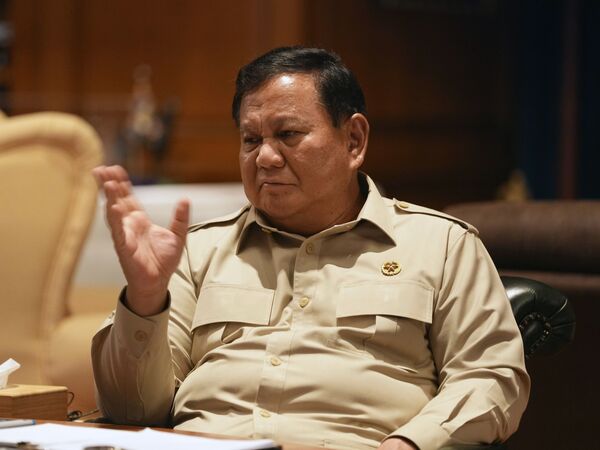
For many, the current turbulence isn’t the result of a single week but the cumulative effect of a series of policy shifts under Prabowo, who this week kept largely out of sight and mum on market developments.
Since taking office, the former defense minister has pursued a far more interventionist economic agenda than many anticipated. He’s expanded the state’s role in strategic industries, seized , mine concessions and processing facilities — an area roughly the size of Switzerland — channeled billions of dollars into sovereign wealth fund Danantara and repeatedly emphasized the need for stronger government direction of economic activity.
Read more:
Supporters argue such measures are necessary if Indonesia is to escape the middle-income trap and accelerate economic growth toward Prabowo’s stated target of 8%. “There’s a false impression that fiscal policy is being poorly managed,” Purbaya said Friday. “All of the president’s policies have been calculated accurately and in detail by the president and us.”
But investors see a huge expenses bill.
The departure last year of Indrawati removed one of the market’s most trusted advocates of fiscal discipline. Since then, concerns have mounted about rising government spending, the sustainability of Indonesia’s fiscal framework and the independence of key economic institutions.
Those worries deepened this week when Prabowo revealed he had ordered an at the National Nutrition Agency after receiving reports of irregularities. He subsequently dismissed agency head Dadan Hindayana and his two deputies, and the three are now detained as part of a corruption probe. They could not be reached to comment.
Prabowo sought to turn the free meals scandal into evidence of his anti-corruption credentials, warning officials in a speech in West Java on Wednesday evening that “my eyes and ears are everywhere” and pledging unlimited support for law enforcement agencies pursuing graft cases.
The president is also seeking to reduce leakage along Indonesia’s borders, with the creation late last month of a new state entity under Danantara to oversee Indonesia’s world-leading exports of palm oil, coal and ferro-alloys, which together amounted to more than $65 billion last year.
Commodity exporters have been scrambling to understand how the new rules will work. While implementation formally began this month, industry groups say crucial details remain unclear.
On Friday, the government at least released a of commodities subject to the regime, showing the rules will capture most of its major palm oil products in addition to coal and ferronickel. Full implementation of the policy is due by Jan. 1.
But the uncertainty is already having real-world consequences.
Some coal exporters have while awaiting clarification and Chinese buyers have reportedly postponed deliveries. Palm oil traders say overseas customers are raising concerns about payments and product specifications under the new arrangements.
The episode has only reinforced the broader criticism being voiced by investors — Prabowo’s unpredictability, compounded by uncertainty about policy direction and then implementation, make Indonesia an increasingly hard sell.
If the government remains on its current policy path, even interest rate hikes won’t be enough “to prevent a further widening of risk premia on Indonesian assets,” Capital Economics’ Tuvey said. All up, it amounts to a “deterioration in the economy’s long-term prospects.”