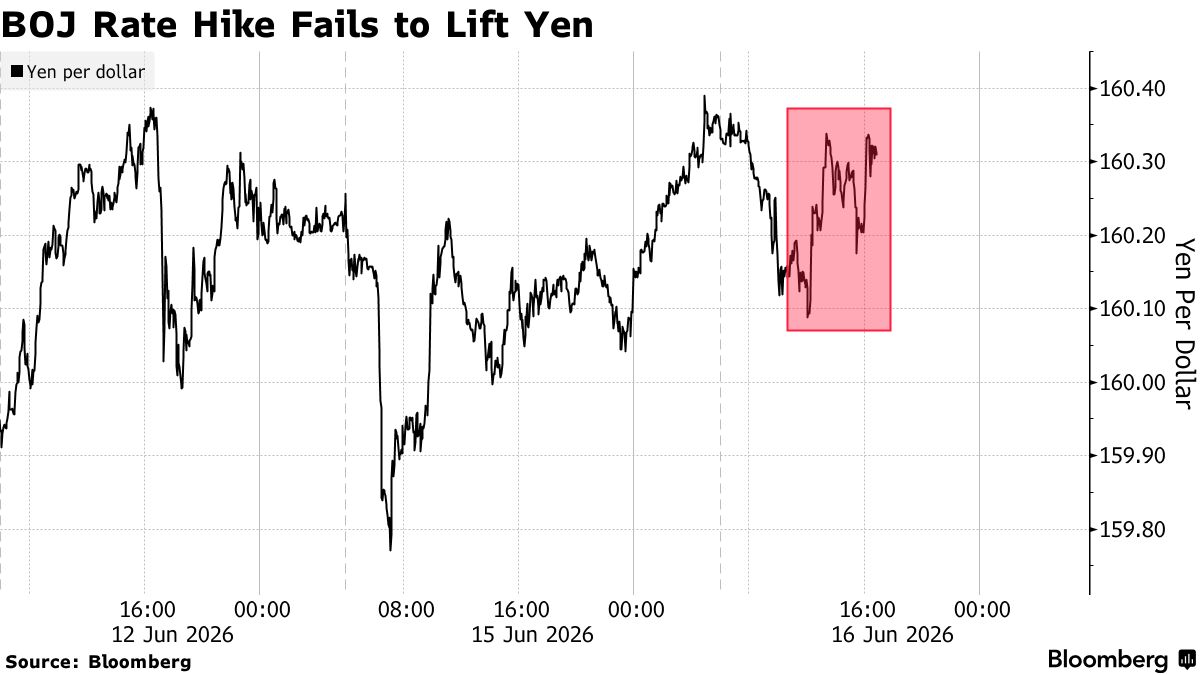
Yen Trims Gain, JGBs Fall on Concern That BOJ Needs to Do More
The yen pared a small advance against the dollar after a Bank of Japan Deputy Governor suggested that policymakers won’t rush into more rate hikes.
Japan’s currency traded at 160.35 against the greenback after Shinichi Uchida said at a press conference that the BOJ will closely monitor the impact of FX on inflation, and that it’s hard to know how much more it will have to raise rates. The pair still traded in a relatively narrow range, after earlier touching 160.05 in the run-up to the BOJ’s widely anticipated rate increase.
Yields on 10- and 20-year sovereign bonds each rose seven basis points, while those on other tenors were also higher on the day on speculation the BOJ may need to move more decisively to stem inflation. The Nikkei 225 Stock Average eked out a small gain .
Uchida’s comments have reinforced the view that the BOJ “remains on ‘auto pilot’ with no urgency to accelerate hikes,” said Masahiko Loo , a senior fixed-income strategist at State Street Investment Management. “The BOJ stance remains broadly supportive for risk assets,” and “in the near term, this keeps upward pressure on long-end yields,” he said.
Policymakers on Tuesday voted to raise Japan’s benchmark interest rate to the highest level since 1995, while one central banker, Toichiro Asada, dissented from the quarter-point rate hike to 1%.
The yen has remained under pressure even as the BOJ gradually increases borrowing costs, as the interest rate differential with the US still remains wide. Just late last week it touched its weakest level since April against the dollar despite Tokyo’s record-breaking currency .
“If USD/JPY stays above 160 despite the hike, it keeps intervention risk alive — especially with the Federal Reserve decision ahead, where a softer dollar backdrop could give Japanese authorities a better window to act,” said Charu Chanana , chief investment strategist at Saxo Markets.
The BOJ also said it would keep its bond buying steady at a monthly pace of around ¥2 trillion ($12.5 billion) from April 2027, suggesting that it was stopping its paring of purchases.
“This suggests that the bank remains cautious in being too aggressive in tightening policy and is willing to trade balance sheet normalization for interest rate normalization,” said Tai Hui , APAC chief market strategist at JPMorgan Asset Management.
Japan’s government bond yields rose to multi-year highs last month on inflation fears stemming from the US-Iran war and the BOJ’s cautious stance. Concerns the BOJ’s hikes may be too few, and too late, have also led to some global funds retreating from the Japanese government bond market.
Read:
The BOJ’s rate hike is the first since December as policymakers grappled with the Middle East conflict. Traders got some this week after the US and Iran said they reached an interim agreement to reopen the Strait of Hormuz, but worries remain surrounding how easy it will be for oil supplies to start moving through the passageway.
Any signs of an improvement in geopolitical tensions may give policymakers in Japan better visibility on the timing of the next rate increase. Officials see the possibility of a further rate hike later this year, people familiar with the matter earlier this month. That said, Prime Minister Sanae Takaichi’s preference for looser monetary policy is seen as a potential hurdle.
“With Asada casting a dissenting vote against the rate hike, it has reinforced the impression that the members appointed by Takaichi are indeed dovish,” said Rinto Maruyama , senior FX and rates strategist at SMBC Nikko Securities Inc. “Lingering concerns about the BOJ falling behind the curve are likely behind the rise in interest rates and the depreciation of the yen.”