Wall Street Embraces the Dollar as Warsh’s Fed Activates Bulls
The dollar is wrapping up one of its best months in a year as a raft of Wall Street banks see a turnaround of fortunes for the US currency.
Strategists at major banks, including JPMorgan Chase & Co., Bank of America Corp. and Goldman Sachs Group Inc., expressed renewed faith in the greenback after Federal Reserve Chairman Kevin Warsh vowed to , spurring interest rate-hike bets.
The Fed has “activated” the dollar bullish outlook, Meera Chandan , JPMorgan’s co-head of global FX strategy, said in an interview. “It doesn’t look like other central banks will catch up and the rate gap will shrink for the dollar.”
The narrative has shifted in recent weeks, reviving speculation that American exceptionalism will support US assets, with data showing an economy that remains resilient against the rest of the world. Meanwhile, artificial intelligence continues to drive massive corporate spending and inflows into the stock market, as investors bet on productivity gains that will further lift the currency.
It’s a massive U-turn from over a year ago when , de-dollarization and the were popular themes for dollar-bashing. They all have died down since then.
Read more:
Even before Warsh took over, the dollar strengthened as investors sought safety after the attacks on Iran in February. The US’s status as the world’s largest oil producer also boosted the greenback after oil prices surged, even though they’re now back to
“The baton of what’s really driving markets now has been passed from energy on to the Fed’s reaction,” Chandan said.
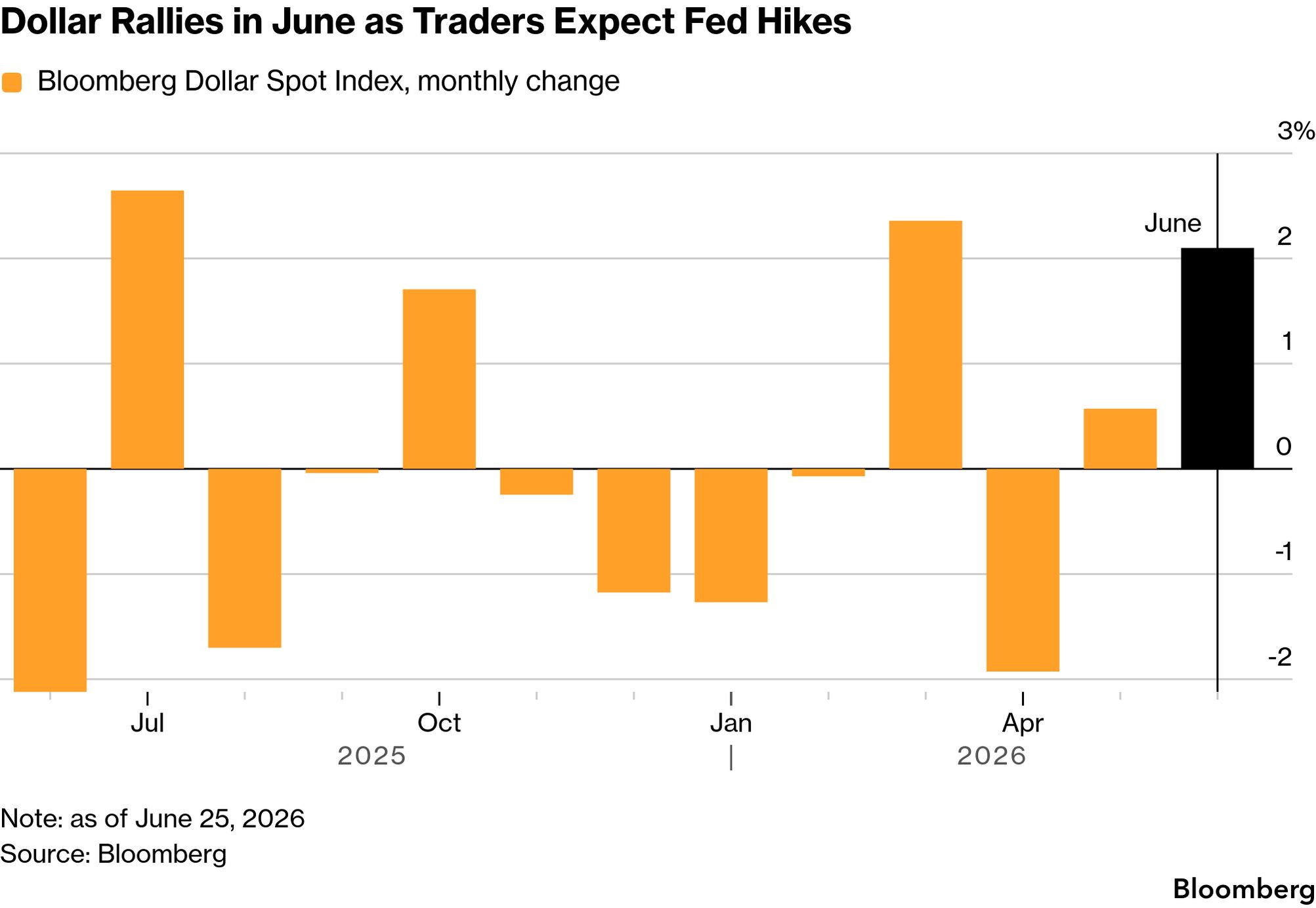
The Bloomberg Dollar Spot Index rose 2.1% so far in June, nearly matching gains seen during the oil-induced rally in March. It’s trading near the highest level since November, having gained 1.7% so far this year.
It’s not just a hawkish Fed emboldening dollar bulls. Even Treasury Secretary Scott Bessent has recently been more vocal about a strong dollar policy, while of Warsh. Bessent, however, said it’s certainty in US policies, rather than the exchange rate, that’s driving the currency’s dominance in the global economy.
Against this backdrop, hedge fund Man Group Plc expects a dollar rally to the tune of 5% by year end, while TD Securities sees a more modest 2% gain in the third quarter.
“US data is resilient, economic activity is strong, a new chair, who is hawkish, is talking about policy, credibility, price stability,” Jayati Bharadwaj , head of FX strategy at TD Securities, said. “The bar to hike interest rates for the Fed is lower now, which is a shift in the perception.”
There are still challenges ahead. To see a more prominent dollar rise, Bharadwaj said the Fed needs to deliver more than the roughly one to two quarter-point hikes the market has priced in through early next year.
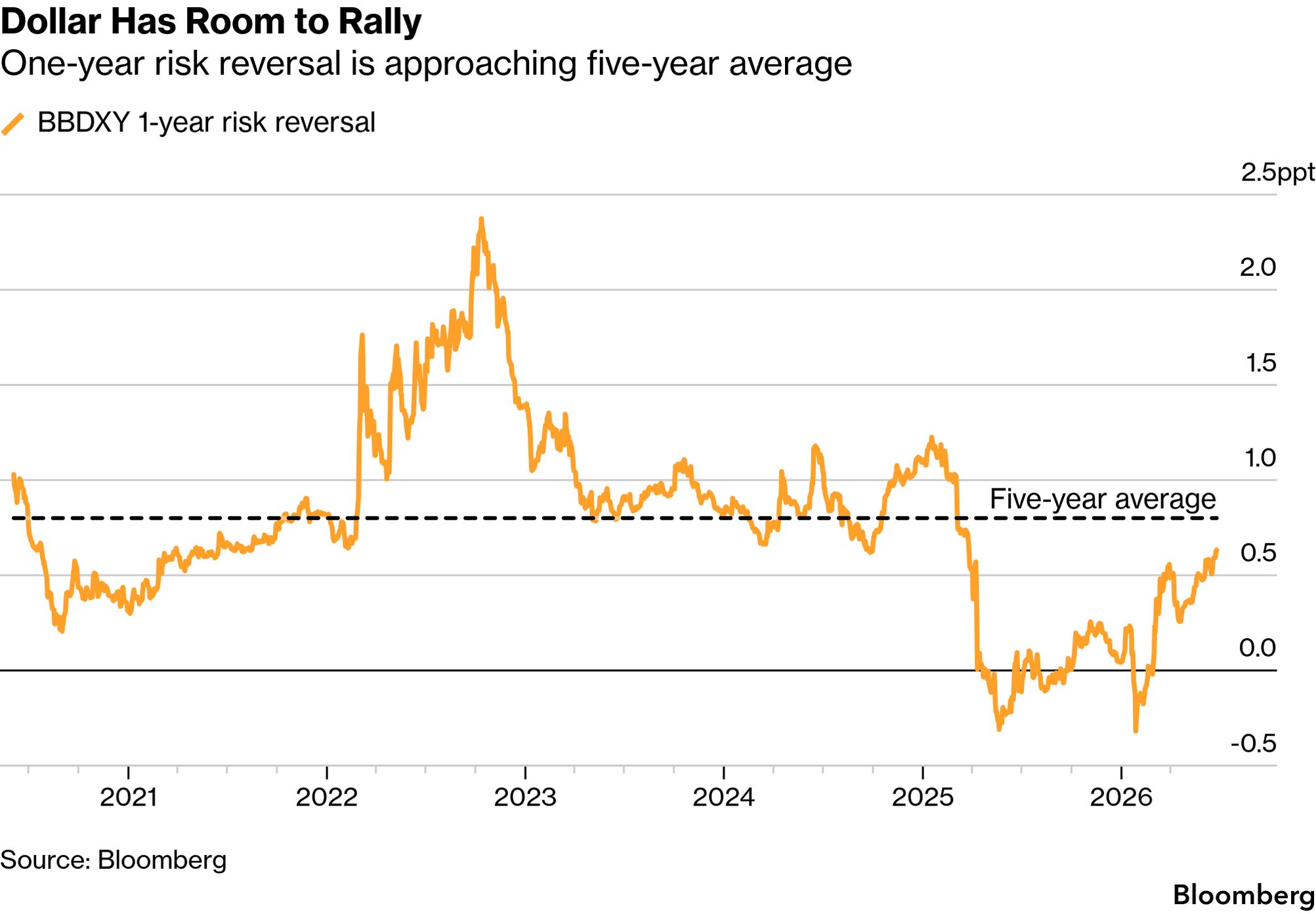
Some signs are emerging that the pace of the rally could slow in the second half. The premium paid to hedge against the US currency gaining relative to falling over the next twelve months against a basket of peers is near the highest level in over a year, approaching the five-year average, though it’s still below levels seen when US exceptionalism last dominated the market narrative.
Barclays PLC strategists said “the dollar’s path may not be linear,” given that Fed hikes are priced in, market sentiment is very bullish, and both oil and US data are likely peaking.
For Alex Cohen , foreign-exchange strategist at Bank of America, the dollar has “more to go.” Bank of America said Thursday it slashed its year-end forecast for the euro to $1.15 from $1.20 previously, expecting the Fed to raise rates three times this year.
Other major central banks are also expected to boost rates but to a lesser degree. European Central Bank President Christine Lagarde pared back hike expectations earlier this week on signs of economic weakness in the region, pushing the euro to the lowest level in a year.
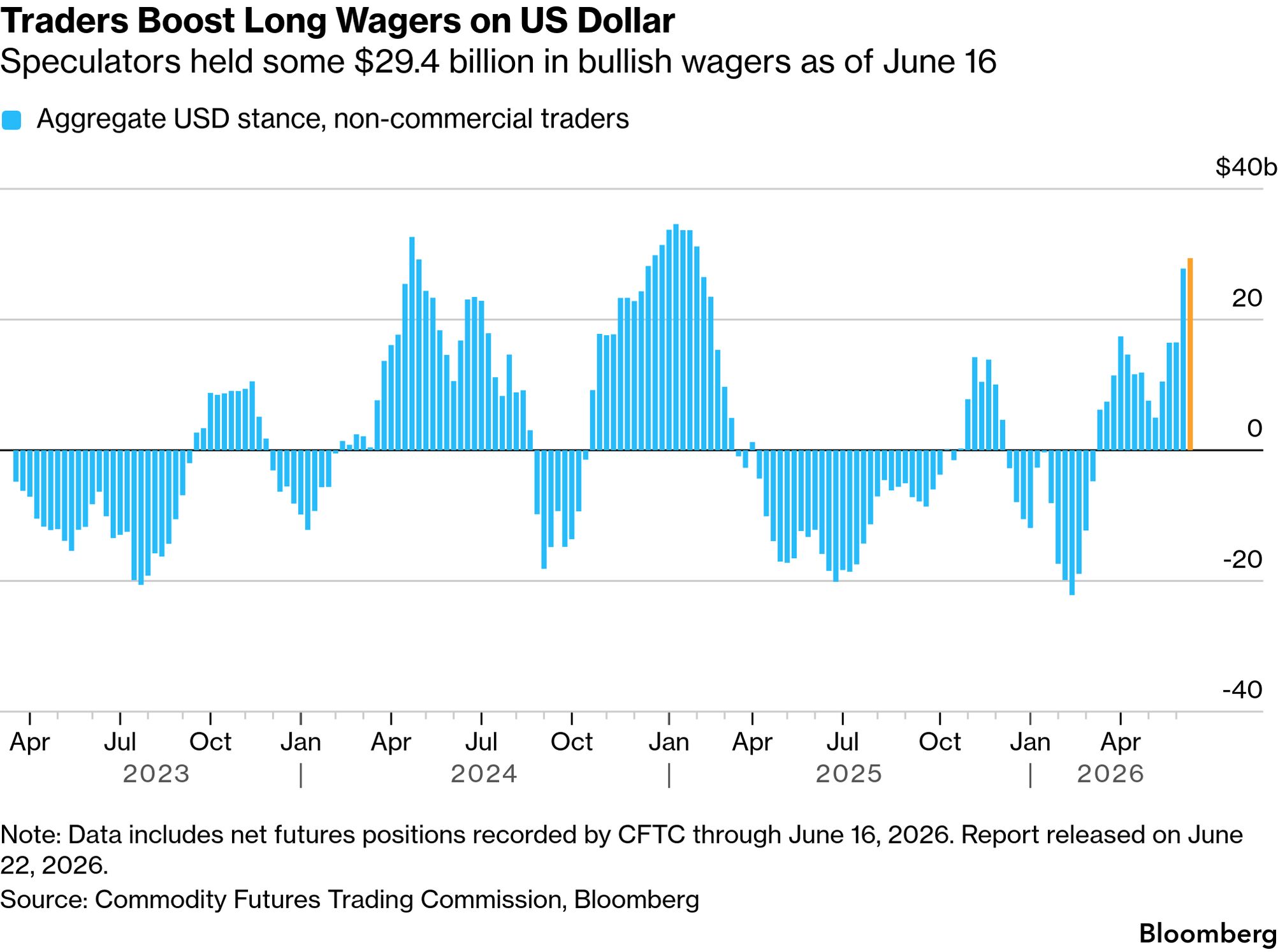
Fast money and investment funds had been piling into trades linked to a dollar rally even before the latest Fed meeting. Hedge funds, asset managers and other speculators accumulated $29.4 billion worth of bets that the dollar would strengthen as of June 16, according to Commodity Futures Trading Commission data released on Monday and compiled by Bloomberg.
Part of what’s spurring the flows, is the AI trade, according to Kamakshya Trivedi , Goldman’s chief foreign-exchange and emerging-market strategist.
“The reality is that the AI trade is boosting both economic growth expectations and equity-market returns in the US, making it an attractive destination for capital,” Trivedi said.
AI-related productivity gains also underpin Standard Chartered PLC’s positive view on the dollar, with capital inflows and higher earnings supporting the currency, according to Steven Englander , the bank’s global head of G-10 FX research. Deutsche Bank’s head of currency strategy George Saravelos sees the dollar as “the predominant beneficiary of future AI income streams.”
Still, Trivedi sees a divided path for the greenback: stronger against lower-yielding currencies, especially those that are sensitive to oil prices, but trailing high-carry and terms-of-trade sensitive currencies such as the Mexican peso, the Brazilian real and the Australian dollar.
“When I think back to late last year, when I was much more negative on the dollar, that view was based on the idea that investors would find better returns outside the US,” he said.
That view has changed with currencies of oil-importing nations, particularly in Asia, and those less exposed to the AI trade, being on the losing end. Goldman sees the Thai baht and the Philippine peso among those weakening against the dollar in the next three months.
“The discussion around reducing dollar exposure is much less prominent than a year ago,” Trivedi said. “Investors are certainly not increasing hedge ratios on their dollar holdings.”