Yen’s Slide Puts Market on Lookout for Japan’s Next Red Line
The yen’s slide to its weakest against the dollar in four decades has left traders looking for Japan’s next line in the sand for the currency.
After dollar-yen 162 on Tuesday, strategists increasingly pointed to 163 and beyond as the next levels to watch, arguing the Finance Ministry may tolerate a weaker currency than during its intervention campaign in 2024. A move to these new thresholds may be swift due to market positioning and US payrolls data this week, they said.
This underscores a shift in mindset among traders, driven by concerns the government could have come in harder with comments aimed at pulling the yen away from the weakest level since 1986. In a broader sense, the Bank of Japan’s historic unwinding of rock-bottom rates is also seen as far too gradual to reverse the currency’s deepening slide.
“The next level to watch is 163,” said Rinto Maruyama , senior FX and rates strategist at SMBC Nikko Securities. Intervention concerns have helped keep the yen stronger than it otherwise would have been following the Federal Reserve’s latest meeting, he said.
Had the currency weakened in line with other major peers, dollar-yen would already be trading around 163 or 164, Maruyama said.
Ikue Saito , a strategist at JPMorgan Chase & Co., said the intervention trigger is now likely higher if authorities adopt the “stealth approach” used during 2024’s operations. The limited effectiveness of the last intervention could also make the Finance Ministry more cautious about stepping into the market too quickly, she wrote, adding that Tuesday’s move suggested stop-losses and option barriers around the 162-162.50 area had been triggered.
The reassessment comes despite consistent verbal warnings from Japanese officials. Finance Minister Satsuki Katayama and Chief Cabinet Secretary Minoru Kihara both on Tuesday that Japan will take appropriate action on foreign exchange at any time as necessary.
Yet this jawboning did little to halt the currency’s decline, with the yen weakening to as low as 162.51 in choppy New York trading, with the currency briefly paring losses before resuming its decline.
The losses came from month-end and quarter-end dollar buying, and from traders unwinding bets on a stronger yen, according to FX traders familiar with the transactions, who asked not to be identified because they aren’t authorized to speak publicly.
Read:
Katayama’s remarks on Tuesday were not as assertive as those given in late April, just before Japan began a record round of intervention. At that time, she went as far as saying that people shouldn’t take their eyes off their smartphones, even when they were out or on holiday.
Ahead of the April 30 intervention, Japan’s top currency official Atsushi Mimura also issued a “final warning” before authorities stepped into the market, highlighting the proximity of the action.
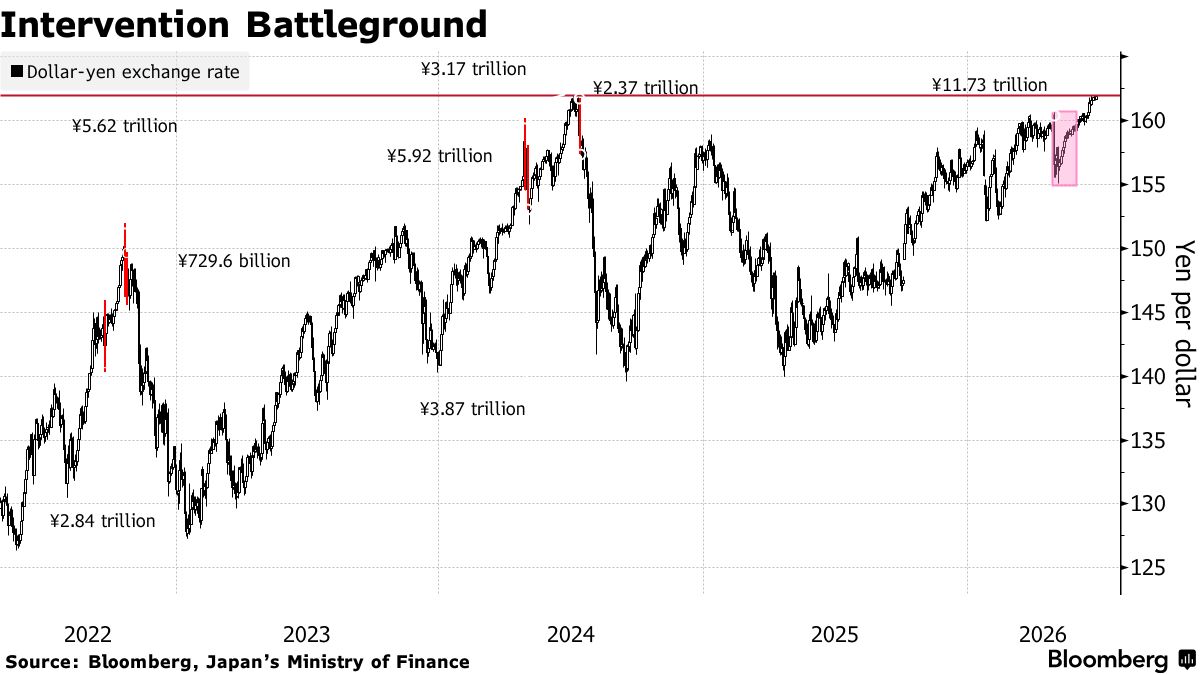
Japan spent a ¥11.73 trillion ($72.4 billion) defending the currency from April 28 to May 27 after it first slid past 160 per dollar. The intervention likely saw Japan draw on its holdings of foreign securities, including US Treasuries, according to Finance Ministry reserve data. Like the intervention campaigns in and , however, this only provided temporary relief before the yen resumed its broader depreciation trend.
The stakes are now high going into US payrolls data on Thursday, which may bring a move to new levels in the yen against the dollar very quickly.
“The break above 162 reinforces that the yen’s depreciation remains a momentum-driven move, with markets now eyeing the 163–165 range as the next key technical and psychological target, where both positioning and policy risk become more acute,” said Masahiko Loo , senior fixed-income strategist at State Street Investment Management.
“The bar for immediate intervention looks somewhat higher ahead of that payroll release, as authorities may prefer to assess whether dollar strength is fundamentally driven,” Loo said.
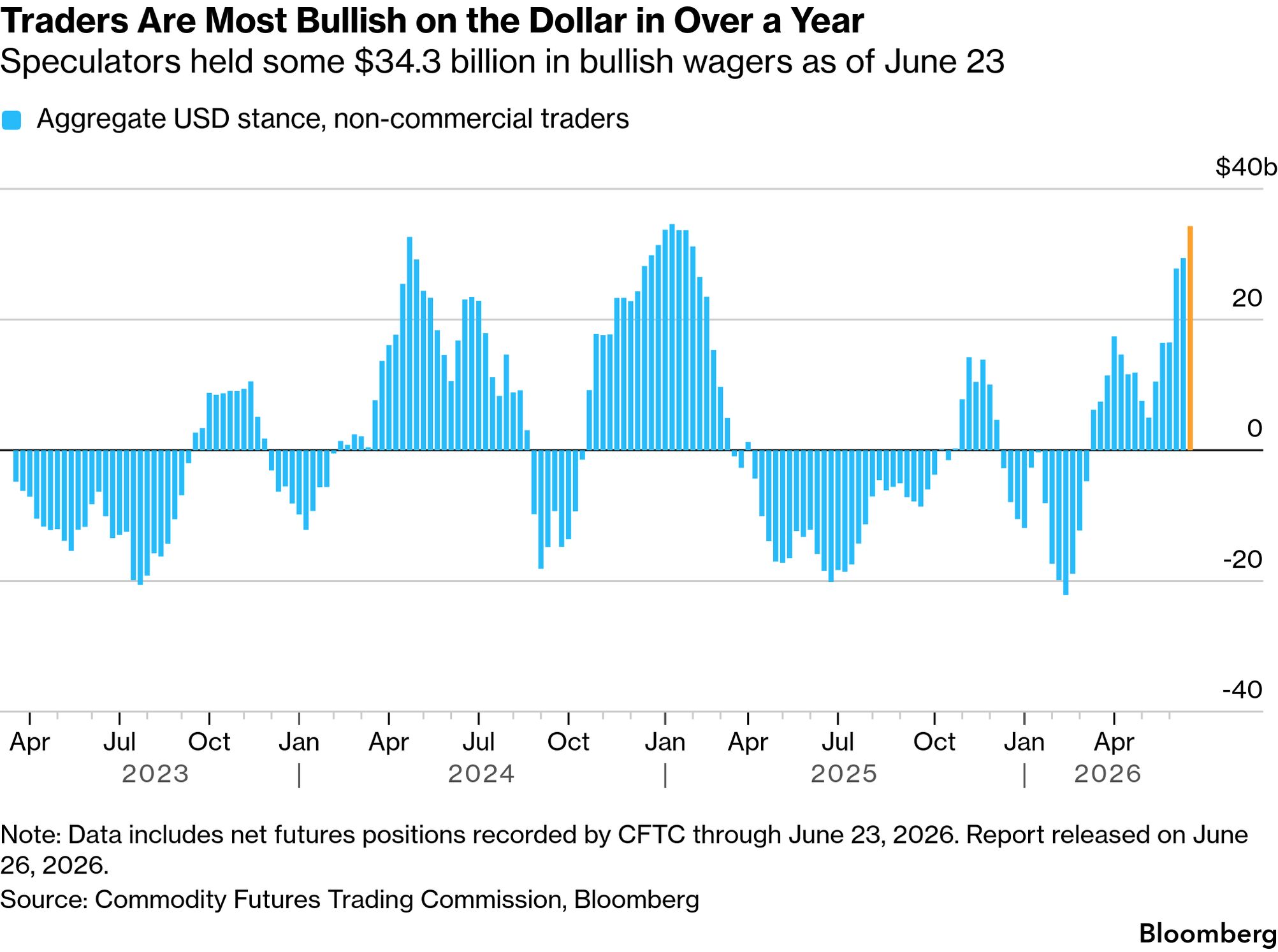
Speculative positioning also remains heavily skewed against the currency. Leveraged funds increased bearish yen positions to 115,033 contracts in the week ended June 23, near the highest level since November 2017, according to Commodity Futures Trading Commission data .
Currency strategists at HSBC including Joey Chew and Paul Mackel said Tuesday that Japanese authorities may be preferring to wait until speculative yen shorts have built further, in order to maximize the impact of any potential intervention. They lowered their forecasts for the yen and now see the currency weakening to the 164 level by the middle of next year.
Read: Warsh Holds Trigger to Fast-Track Yen Selloff: Trader Talk
The BOJ its benchmark interest rate to 1% earlier in June, the highest level since 1995, but traders expect the Fed to become relatively hawkish, preserving the wide interest-rate gap that has kept pressure on the yen.
Investors are also becoming increasingly concerned that the Japanese government wants the BOJ to proceed cautiously with further tightening, after reports that it will call for “ ” monetary management in its basic policy guidelines.
SMBC Nikko’s Maruyama said that effectively limits the scope for faster rate hikes while introducing additional fiscal risks. “The combination has led to higher and, ultimately, renewed yen selling,” he said.
Chidu Narayanan , chief Asia-Pacific strategist at Wells Fargo, said markets are likely to keep probing where Japanese authorities are prepared to act.
“Markets are likely to test the MOF’s appetite for intervention as USD/JPY edges higher,” he said. While verbal warnings have helped stabilize the currency at times, “actual intervention will be required to credibly maintain intervention fears.”