Venezuela Accelerates Effort to Shrink Black-Market Currency Gap
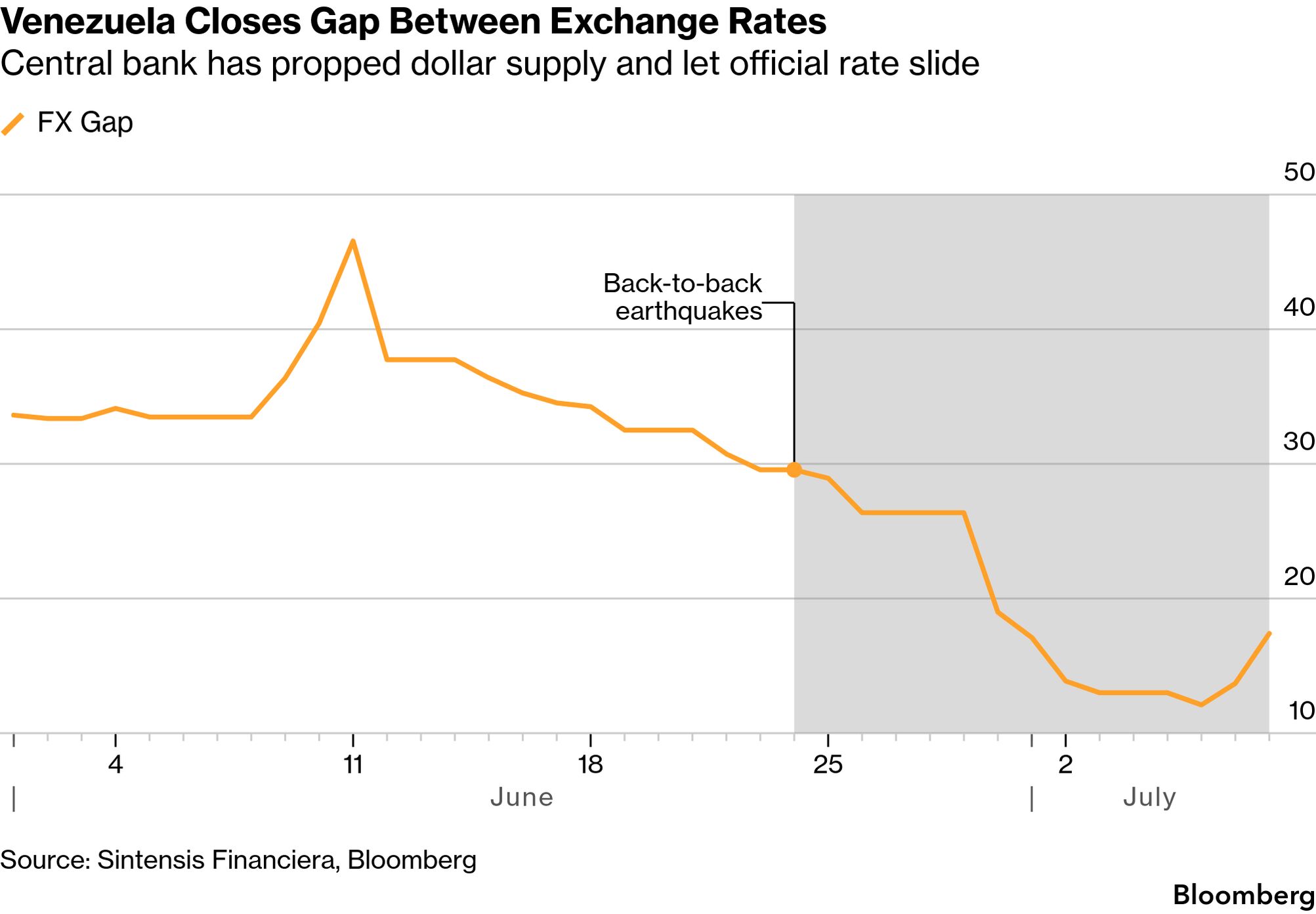
Venezuela’s efforts to stabilize its currency have narrowed the differential between the official and black-market exchange rates, a key aim of a government strategy to curb inflation and bolster an economy now facing additional strains after two earthquakes.
The government has been pouring dollars into the local market — more than $7 billion since January, according to private estimates — draining bolivars from the financial system as part of a restrictive policy intended to steady the weakening currency. At the same time, authorities have allowed the official exchange rate to depreciate more quickly, bringing it closer to the parallel market rate.
Venezuela has been able to tap oil revenue to raise dollars under a program closely overseen by Washington as it works together with the acting administration of Delcy Rodriguez to stabilize the economy following the US capture of strongman Nicolas Maduro in early January. Dollar sales by the government have increased in recent months due to higher oil prices, which surged as the war between the US and Iran intensified.
“The gap narrowed mainly due to a greater supply of dollars and because the official rate is being adjusted to reflect reality, not because the economy has been fixed,” said Luis Vicente Leon , an economist and president of Caracas-based pollster Datanalisis. “This doesn’t mean the problem is over. We need to be consistent, restore confidence in monetary and fiscal policy, and examine the impact of the earthquakes on financial flows.”
Read More: Wildcatters Seek a Piece of Venezuela’s Oil Boom Despite Quakes
The central bank rate, now about 686 bolivars per dollar, is 17% stronger than the rate on crypto trading platforms, down from roughly 30% in the days before the earthquakes hit. The currency has depreciated by almost 11% since in the official market, with a rush of aid-related dollars probably playing into the dynamic.
The quake aftermath also likely impacted the demand for bolivars due to a higher consumption of basic goods in June, which served to drain the currency from the market, Leon said. Authorities are also restricting bolivar liquidity by keeping a tight leash on spending and forcing banks to park about 73% of deposits in an account at the central bank.
All of this has helped keep the rate differential between the official and parallel markets from expanding like in other periods of high uncertainty, such as the aftermath of Maduro’s capture, when concerns over future dollar supply drove the gap to more than 100%, destabilizing local trade and putting pressure on prices.
Read more:
“The critical question is what’s going to happen once the two rates converge,” said Tamara Herrera , head of local consultant Sintesis Financiera. It was becoming too costly for the government to reduce the gap just by selling more dollars, so they had to allow for the central bank rate to depreciate, she said.
There are also other measures on the way to ease demand in the parallel market. Caracas-based consultant and economist Asdrubal Oliveros wrote in an that dollars in cash have arrived in the country to be sold by local banks — presumably related to Washington-approved oil revenue.