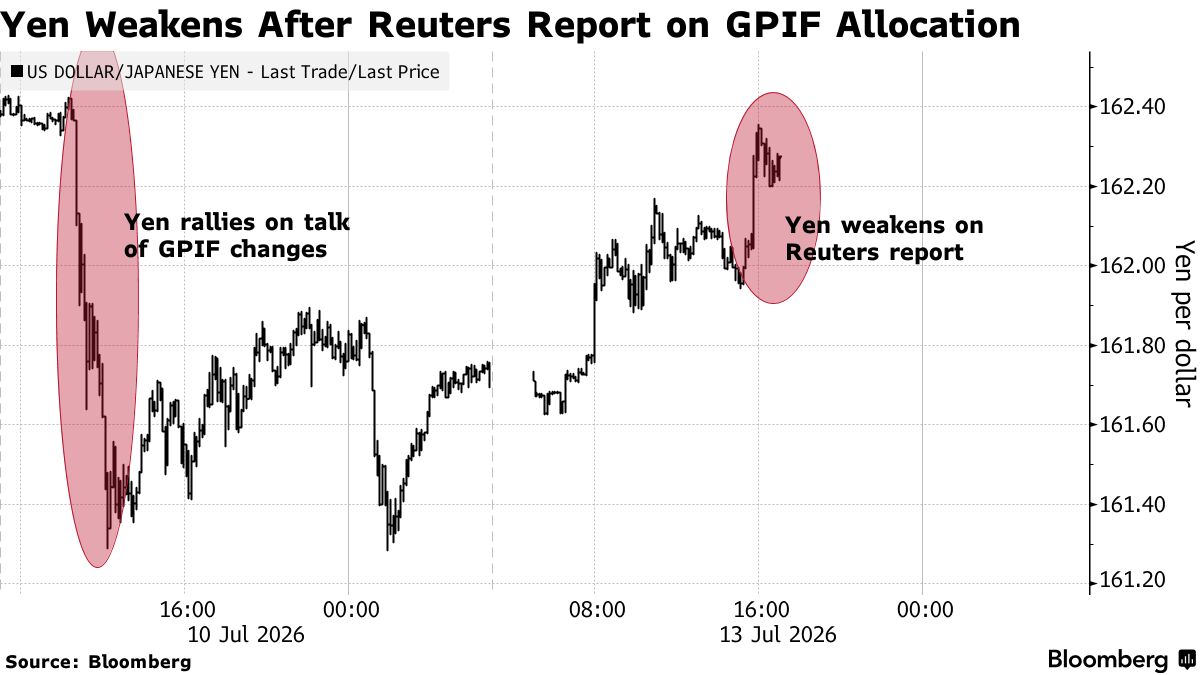
Yen Falls on Report Japan Has No Plans to Change GPIF Allocation
The yen weakened and Japanese government bonds extended losses after Reuters reported that Japan has no plans to overhaul the Government Pension Investment Fund’s asset allocation.
The Japanese currency dropped as much as 0.4% to 162.36 per dollar. It pared back some of the losses after Chief Cabinet Secretary Minoru Kihara said the GPIF routinely undertakes an appropriate review of its portfolio and will make amendments if required.
Read more: Japan’s Kihara Says GPIF Conducts Routine Portfolio Reviews
Speculation that the $1.8 trillion GPIF could shift more money into domestic assets gathered pace after Finance Minister Satsuki Katayama last week Japan’s large pension funds, including the GPIF, to increase investment at home. The remarks triggered gains in the yen and JGBs.
“Even if the likelihood of an immediate large-scale portfolio revision remains low, markets are likely to continue focusing on the possibility of a gradual shift toward domestic assets through greater use of the permitted deviation bands or changes in day-to-day rebalancing practices,” said Masayuki Nakajima , senior currency strategist at Mizuho Bank in London.
Bloomberg reported on Friday that market participants were skeptical the GPIF would respond to Katayama’s remarks in the near term, given the pension fund’s governance framework and fiduciary responsibilities. Some investors even viewed Katayama as jawboning to stem the yen’s latest slide and the selloff in government bonds.
Reuters’ report on Monday said the government could work within existing allowable ranges to funnel more investment from its state pension funds to domestic assets, citing unidentified sources.
The GPIF reviews its strategic asset allocation once every five years. In March 2025, the fund decided to keep splitting a quarter of its funds equally between domestic stocks and bonds, as well as foreign equities and debt. The fund also cut the maximum deviation from its targets to 5-6 percentage points depending on the movement of the various asset classes, from 6-8 percentage points previously.
Read more:
Any change to that strategic asset mix would require a formal review process rather than a political directive. By law, the fund’s investment decisions must be guided by the objective of delivering sustainable long-term returns for pension beneficiaries, meaning a larger allocation to domestic assets would need to be justified on investment grounds rather than broader economic or policy goals. That may be a difficult case to make after foreign stocks and bonds outperformed their Japanese counterparts for much of the past decade.
“There’s no way GPIF will sacrifice its discipline because the government thinks it’s a good idea,” said Amir Anvarzadeh , a strategist at Asymmetric Advisors, adding that dollar-yen “may be on the cusp of a big breakout.”
The yen remains above 162 per dollar, near its weakest level in four decades, despite a ¥11.73 trillion ($72.3 billion) intervention by the authorities earlier this year after it first slid past 160. Geopolitical risks, fiscal concerns and wide interest-rate differentials continue to weigh on the currency.
Meanwhile, Japanese government bonds are under pressure as investors fret over Prime Minister Sanae Takaichi’s ambitious spending and investment plans. Her perceived dovish stance on monetary policy has also fueled concerns that the Bank of Japan is raising interest rates too slowly to contain inflation, weighing on longer-dated debt.