China Gets Pat on the Back From Moody’s Even as Debt Load Swells
Moody’s Ratings revised China’s credit outlook to stable from negative, an expression of confidence in the economy as the government copes with risks stemming from its swelling debt load.
The upgrade “reflects our assessment that economic and fiscal strength will be resilient to ongoing domestic as well as trade and geopolitical challenges,” Moody’s said in a statement on Monday. “Fiscal pressures will persist, and the government’s debt burden will continue to increase for the foreseeable future but with contained downside risks.”
The company also affirmed China’s long-term rating at A1 — where it’s been for nine years — keeping it four notches below the top ranking and on par with Japan, Kuwait and Belgium. None of the three major credit assessors have upgraded China’s rating since President Xi Jinping came to power in 2012.
The onshore yuan was little changed at around 6.8 per dollar on Tuesday, while the yield on 10-year government bonds held near 1.8%. While the market reaction was muted, analysts at financial institutions including Bank of New York Mellon said the revision should be supportive for Chinese assets including government debt.
BNY’s senior APAC market strategist, Wee Khoon Chong , called the decision “yet another positive factor” and a “show of increasing confidence” toward the country’s macroeconomic fundamentals, saying Chinese bonds will probably “continue to outperform peers on a contained inflation outlook and overall flush liquidity conditions.”
Moody’s has turned more upbeat on China’s growth prospects since to negative in late 2023, when it warned that Beijing’s support for provincial governments and the country’s property downturn were threatening the economy.
Since then, China has embarked on its most aggressive effort in years to reduce “hidden” or off-balance sheet debt by reining in borrowing by companies linked to regional authorities to fund infrastructure investment. Beijing has directed local administrations to sell more bonds that replaced much of that debt.
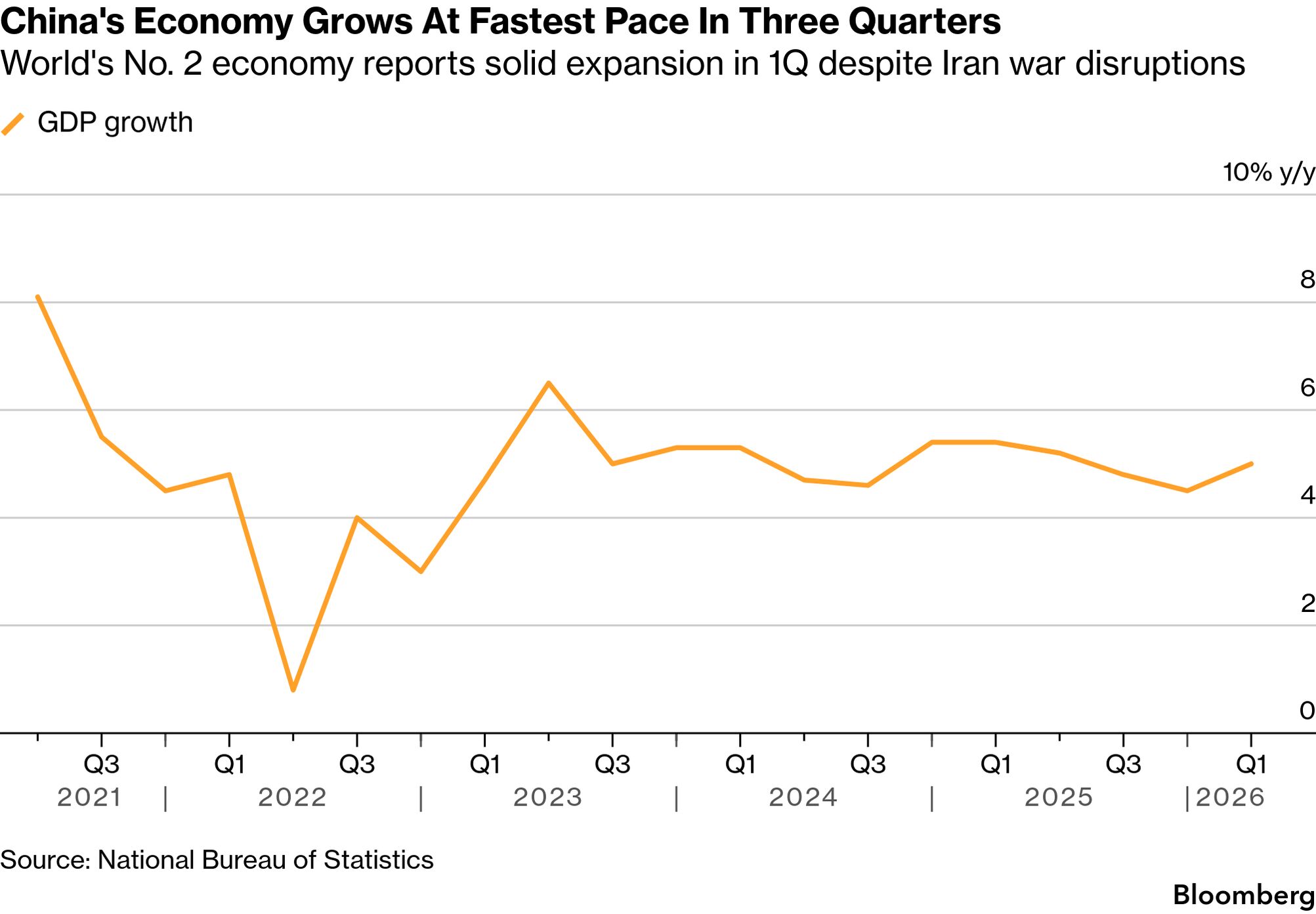
And with economic growth on track to reach 4.5% in 2026 and 4.2% in 2027 — far more than Moody’s had forecast three years ago — the rating company said the government now has the “space for the continuity of policies to address structural challenges without extending significantly larger policy support.”
The A1 rating already “incorporates an erosion in the strength of public finances,” according to Moody’s, with the government’s debt burden rising by over 20 percentage points in the past five years to 68.5% of gross domestic product. The rating company sees debt reaching 82.4% of GDP next year and exceeding 90% by the end of the decade.
Bloomberg Economics expects the combined debt of the central and local governments to climb to 101% of GDP at the end of 2034, up from 61% at the end of 2024.
China’s Ministry of Finance welcomed the announcement by Moody’s, pledging that it will continue pushing for economic restructuring and strengthening fiscal sustainability. “We will respond to uncertainties in the external environment with the certainty of our sustained, healthy economic and social development,” it said in a issued following the Moody’s release.
On Tuesday, China’s leaders for their first economy-focused meeting after the war in Iran broke out in February. According to a readout published by the the Xinhua News Agency, the Communist Party’s decision-making Politburo led by President Xi Jinping highlighted better-than-expected growth so far this year, pledging to counter external shocks and calling for “targeted and effective” deployment of fiscal and monetary policies.
Growth in the world’s second-largest economy has been strong so far in 2026 as exports continued expanding while China’s years of efforts to beef up energy security limited the Iran war’s impact on domestic activity. Foreign investors’ interest in yuan assets has been rising, with overseas funds’ trading of Chinese onshore bonds via Hong Kong hitting a last month.
The country’s export competitiveness means GDP growth will slow “only gradually over the medium term” as policymakers are expected to manage the campaign to rein in local debt risks “in a controlled fashion,” according to Moody’s. “China’s economic strength provides very significant support to the rating.”
The country’s “extremely large and diversified” economy and increasing competitiveness in higher value-added sectors are set to offset challenges posed by its aging population, Moody’s said.
Chinese authorities will be able to pursue reforms at a “gradual” pace and maintain financial stability in an environment of low interest rates and high domestic savings that limits debt-servicing costs, it said. Demand for government debt will be ensured as China’s financial system is predominantly state-owned, it added.
Chinese assets including bonds have been among the best performers globally as investors sought shelter from the Iran war, thanks to the country’s stronger resilience against the oil shock, weak domestic inflation and ample liquidity at home.
For all the optimism about the outlook, ING Bank NV’s Lynn Song said the move by Moody’s will have only limited impact on bonds given their yields are already very low. China’s benchmark yield has been trading below Japan’s .
Even so, the change by Moody’s is “another milestone in the normalization” of investor views of China, said Song, chief economist for Greater China at ING. “It is a positive sign and acknowledgment of China’s efforts to address the risks from the local government debt challenge.”