Intervention Data Eyed as Yen Edges Back Toward 160 Per Dollar
Currency traders are counting down to Friday for an official figure from Japan’s finance ministry that will show how aggressively authorities intervened to support the yen over the past month.
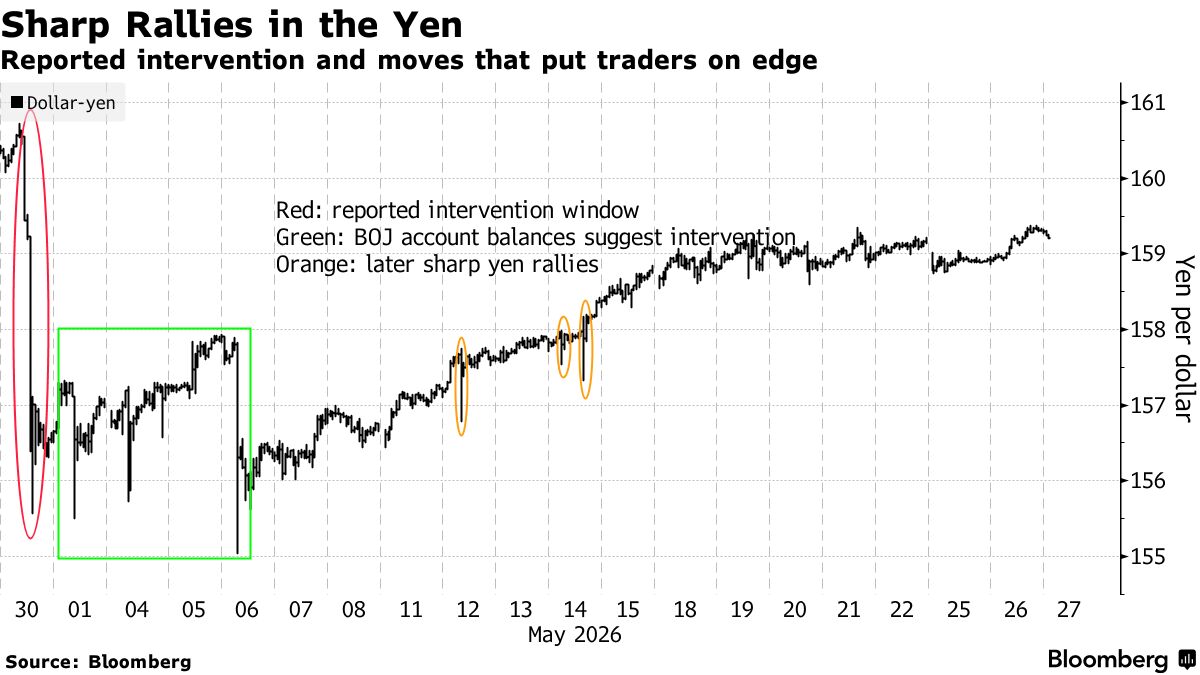
This comes as the yen remains under pressure near 160 per dollar, having given up the bulk of the gains it made in late April and early May when the ministry ordered the central bank into the market to defend the currency. It was down slightly to 159.60 as of 1:04 p.m. in Tokyo, with traders alert to the risk of further intervention.
Initial analysis of Bank of Japan accounts by Bloomberg indicates that about as much as ¥10 trillion ($63 billion) was spent to the yen from April 30 through to the end of the nation’s Golden Week holidays on May 6. While Japanese officials have declined to comment directly on whether they intervened, a person familiar with the matter said it took place on April 30 and price moves through May 6 bear the hallmarks of government purchases.
“The MOF data is crucial,” said Masahiko Loo , senior fixed income strategist at State Street Investment Management. “A print meaningfully above ¥10 trillion underscores policy commitment.” Loo said that if the exchange rate does not hold even after spending that amount, it could raise questions about intervention’s effectiveness.
A lower level of intervention could mean Japan is making deployments tactically or there is a greater reliance on underlying market dynamics, Loo added.
Read:
The is scheduled to be announced at 7:00 p.m. local time on Friday, showing the total intervention amount for April 28-May 27. The finance ministry typically releases daily operational data in August.
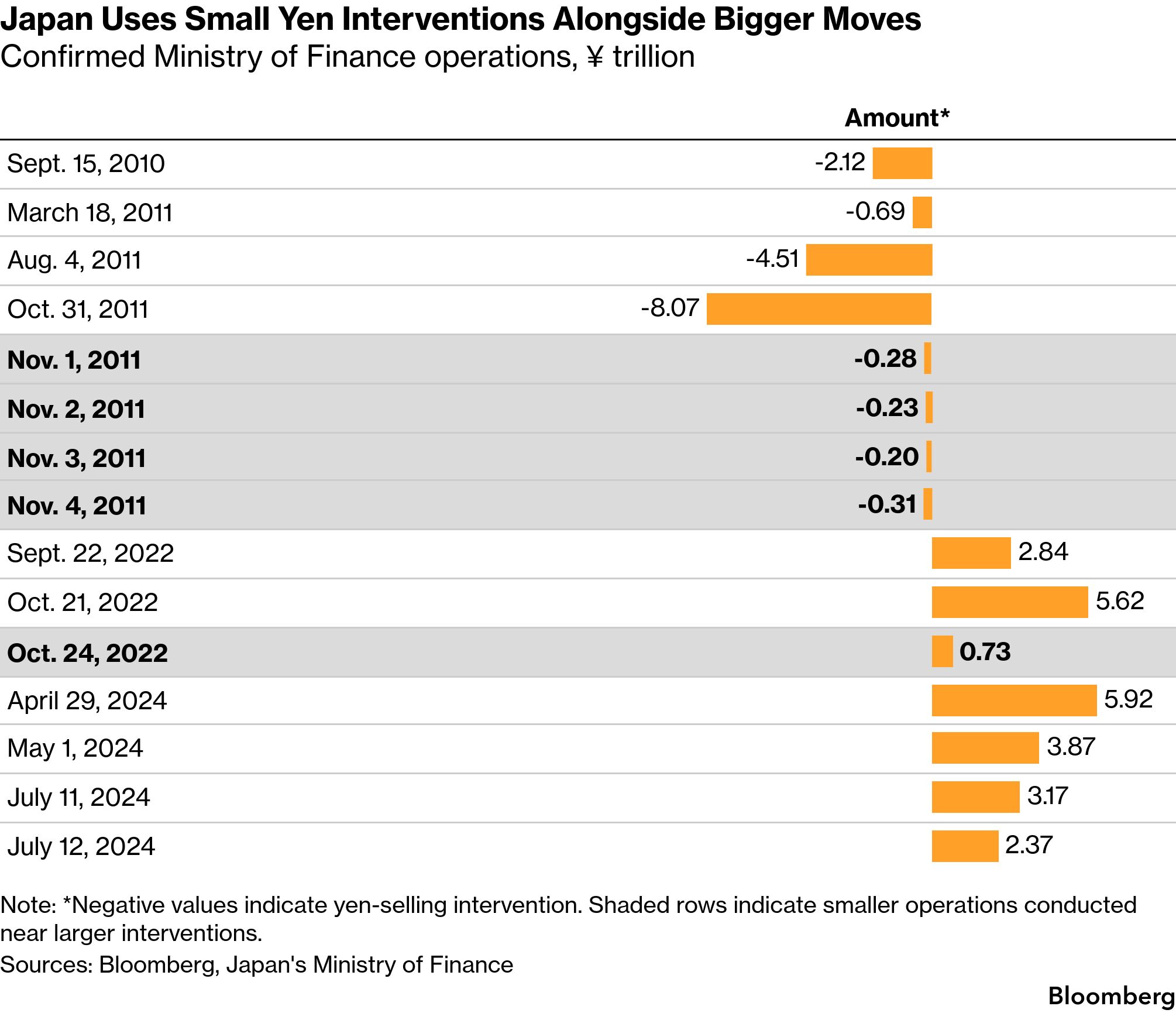
Japan’s currency saw multiple bouts of gains in May, sparking debate among investors as to whether the finance ministry is conducting smaller operations. While the MOF data on Friday will not provide a daily breakdown, traders may speculate based on the figure whether mini-interventions occurred.
The authorities have a history of pairing large currency interventions with smaller ones. In late 2022, a ¥729.6 billion yen-buying operation followed a much bigger ¥5.62 trillion intervention aimed at slowing yen weakness.
Read:
If the data implies that the finance ministry was carrying out smaller interventions, “the market is probably going to prepare for a more active intervention stance,” said Shinichiro Kadota , head of Japan FX and rates strategy at Barclays Securities Japan Ltd. “But it also could simultaneously raise the question that if they were doing it, why was it not really working.”
When Japan last in 2024, it spent ¥5.5 trillion over the period from June 27 to July 29. The amount was largely in line with earlier estimates based on the BOJ’s accounts and money broker forecasts.
The still-wide interest rate differential between the US and Japan has also been weighing on the yen after the BOJ held rates steady last month. Traders are pricing in that the Federal Reserve is virtually certain to rates this year under new chairman Kevin Warsh.
“Dollar-yen has already unwound most of its post-intervention decline within a matter of weeks, which underscores how strong the underlying market forces supporting the pair remain,” said Carol Kong , a currency strategist at Commonwealth Bank of Australia. “With fundamentals favoring dollar-yen, a sustained campaign of FX intervention may be needed.”
International Monetary Fund state that conducting up to three episodes of currency interventions within six months is consistent with a “free-floating” exchange-rate regime, according to a Japan Finance Ministry official. If the authorities exceed that number, then the IMF tends to classify the exchange-rate regime as “floating” rather than free-floating, the official said.
Finance Minister Satsuki Katayama recently her willingness to step into the market if needed to prop up the yen. US Treasury Secretary Scott Bessent also characterized excess foreign-exchange volatility as undesirable in another indication of tacit US approval of Japan’s recent interventions.
“We still see a high risk of additional intervention if dollar-yen tests or breaches 160 again,” said Yujiro Goto , chief FX strategist at Nomura Securities. If it turns out the previous intervention amount was more than ¥10 trillion, markets may view it as less effective and may push dollar-yen higher, he said.
Read:
Goldman Sachs Group Inc. Japan has the resources to intervene on a scale similar to that seen in late April around 30 more times, though it expects officials to conserve reserves and act selectively. Japan’s foreign currency reserves were worth $1.17 trillion as of the end of April, according to an MOF report published earlier this month.
Some strategists warn that intervention only buys time and doesn’t change the economic fundamentals behind the yen’s weakness. The market will be closely watching the BOJ’s June policy decision, with overnight index swaps showing about an 80% chance of a hike.
“FX intervention remains a bridge, not a solution. The heavier policy burden increasingly shifts to the BOJ,” said Loo. “A sustained reversal in yen weakness will also require a broader convergence of factors, including geopolitical stabilization, normalization in energy prices and a supportive shift in the Fed’s policy path.”