New Zealand Dollar Faces Tough Third Quarter on Growth Headwinds
New Zealand’s dollar is facing a subdued third quarter as a resurgent greenback and the lingering effects of the Iran war’s energy shock drag on the domestic recovery.
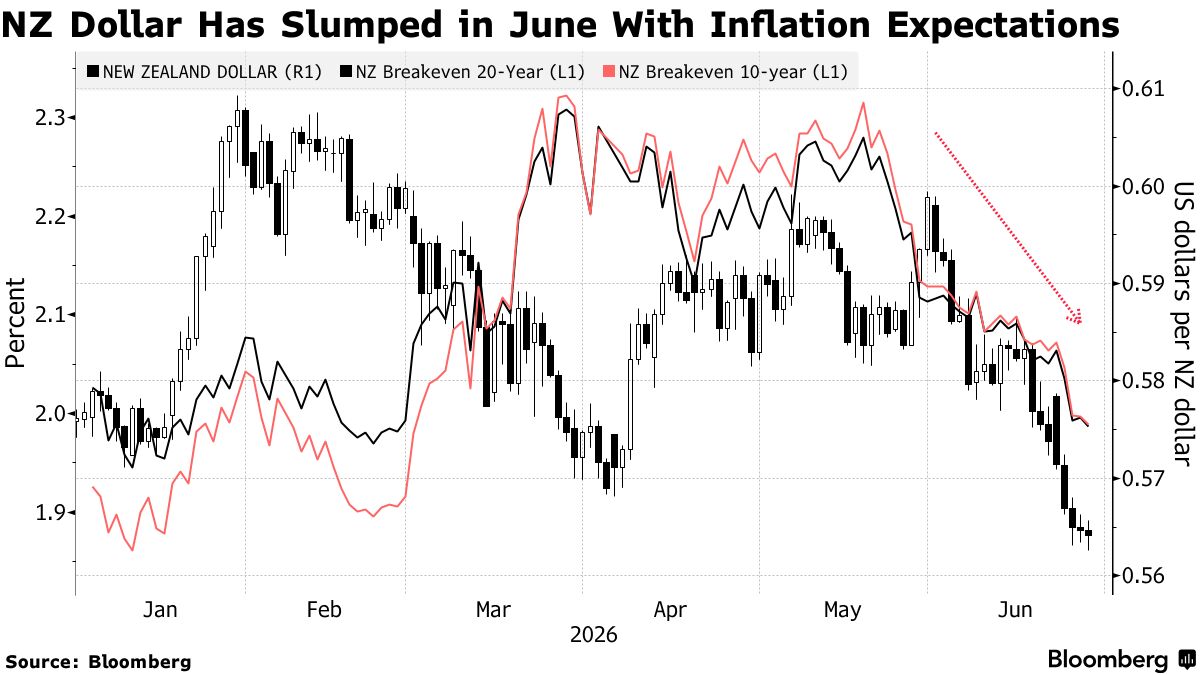
Westpac Banking Corp. forecasts the currency to weaken to 55 US cents by end-July while ABN Amro Bank NV sees it dipping below the November low of around 55.8 cents. The kiwi dollar has already fallen around 5.8% so far in June to 56.41 cents, on track for its biggest monthly drop since 2024.
It’s an about-face for the kiwi dollar after it ranked among the top three Group-of-10 currencies in the first five months of the year when traders initially priced in rapid Reserve Bank of New Zealand rate hikes to tame energy-linked consumer costs.
Since then, expectations for aggressive RBNZ policy tightening have been dialed back. And while a recent slump in oil prices — following a fragile US-Iran ceasefire deal — has tempered immediate inflation fears, the structural economic damage from the initial energy shock remains. The greenback’s strength on US economic resilience is adding further pressure on the kiwi.
“We remain bearish on the kiwi dollar,” said Imre Speizer , a strategist at Westpac in Auckland. We “would consider selling upon a bounce to around 57 cents,” he said.
Investors are watching domestic business and consumer confidence data this week to gauge the economy’s health, with the nation’s four largest banks predicting growth contracted in the second quarter. A surge in fuel prices has , dashing hopes that strong exports and a would underpin a steady recovery.
While local swaps fully price in two rate hikes by year-end and a 30% chance of a third, for Commerzbank AG strategist Volkmar Baur , “that’s too much.” He expects a July rate hike, with a second increase possible in September or October.
“New Zealand’s economy is too weak, and CPI will be trending down by then because energy is better,” he said. Baur sees the currency edging higher to 59 US cents by end-September but sees downside risk to that forecast.
While near-term pressures dominate, some analysts expect the kiwi to gain ground later in the year as the domestic recovery takes hold. Green shoots are already emerging, with both mortgage applications and job prospects showing modest improvement.
The kiwi could revisit its November low below 56 US cents due to the dollar’s momentum, but “we expect the New Zealand dollar to recover again afterwards,” said Georgette Boele , a senior strategist at ABN Amro Bank NV in Amsterdam.
Boele views current market pricing for the Federal Reserve as overly hawkish. “We expect the US dollar to give back gains across the board,” she said.
Still, the kiwi may struggle to rally. The currency has weakened 2% on average in the third quarter over the past decade, according to Bloomberg data. Options traders see a better than even chance the currency will remain below 57 US cents at the quarter’s end, according to data compiled by Bloomberg.
“It’s tough to be bullish NZ dollar right now,” said Abbas Keshvani , a macro strategist at Royal Bank of Canada in Singapore who sees it drifting around 57 US cents in the third quarter.
This week’s main economic events: