Wall Street Talks Up Carry Trade as Returns Soar Most in Decades
One of the most enduring foreign-exchange bets is off to its best run in decades as surprisingly muted volatility across asset classes has investors piling into carry trades.
The strategy, which involves borrowing in low-yielding currencies to invest where returns are higher, has proven a winner in 2026 as the global economy remains unexpectedly resilient in the face of the oil shock spurred by the Iran war. That backdrop is suppressing market swings and buoying risk appetite among traders seeking out lofty yields in developing nations.
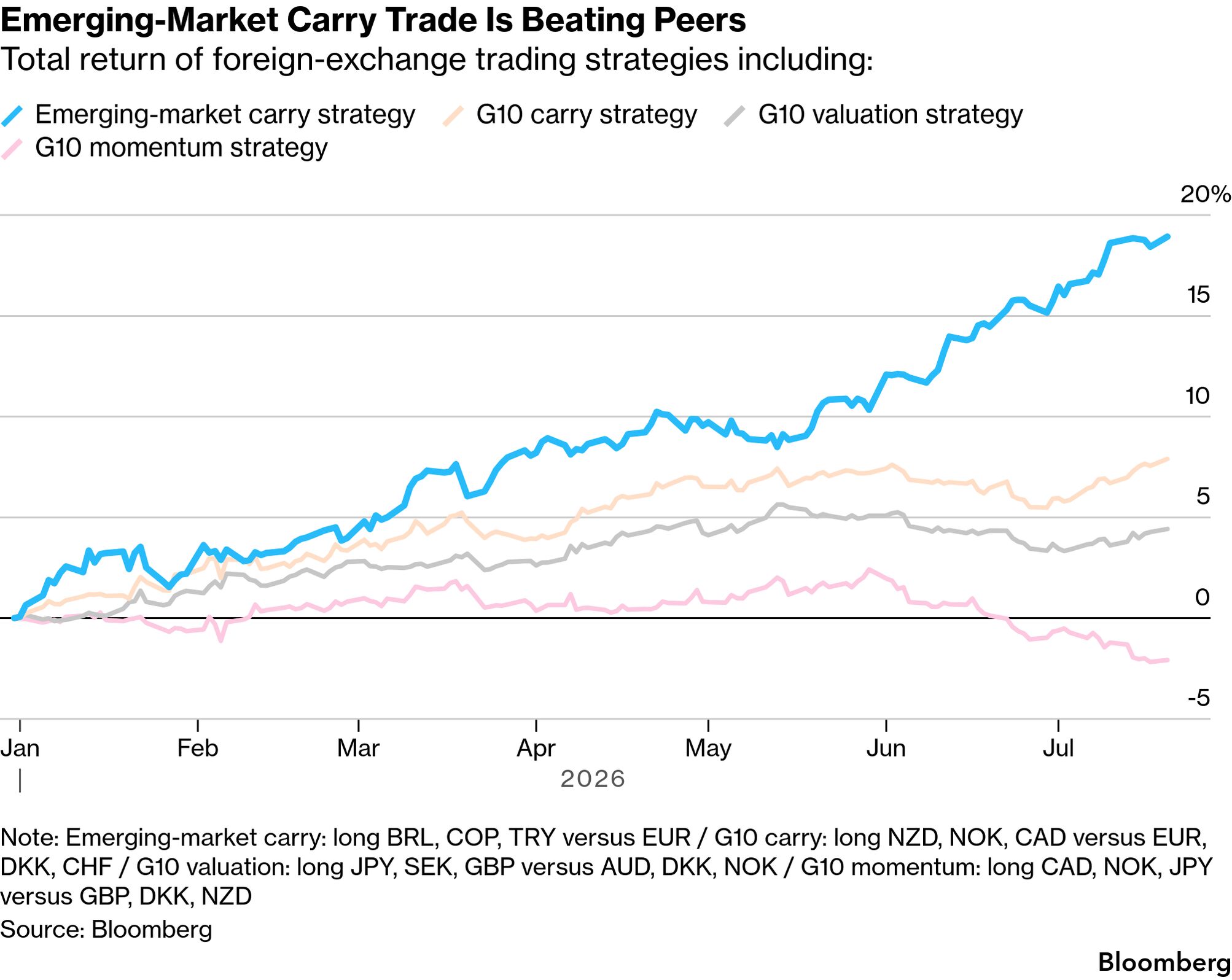
One version that strategists at Citigroup Inc. and other banks have been citing lately involves borrowing in euros to buy a basket comprising the Brazilian real, Colombian peso and Turkish lira. It’s up roughly 18% this year through last week, the most year-to-date since 2005, data compiled by Bloomberg show.
Carry has been the strongest strategy for currency traders this year, handily outpacing widely followed alternatives such as the momentum or value approaches. Citigroup, Goldman Sachs Group Inc. and JPMorgan Chase & Co. are in research, and investors such as Nuveen and Vontobel say it likely has room to run.
“Carry is a gift that has kept giving” even as Mideast tensions flared anew in the past month, JPMorgan strategists led by Meera Chandan said in a research note on Friday. “With foreign-exchange volatility at new cycle lows, our expectation is for carry to continue to deliver.”
Traders traditionally use a variety of currencies to fund the carry strategy, including the dollar and especially the yen, given that interest rates in Japan were around zero for decades. Turning to the euro as the base currency makes sense as a way to diversify, and the region’s benchmark rate, at 2.25% , is lower than the Federal Reserve’s range for its target , of 3.5%-3.75%.
Dollar Stability
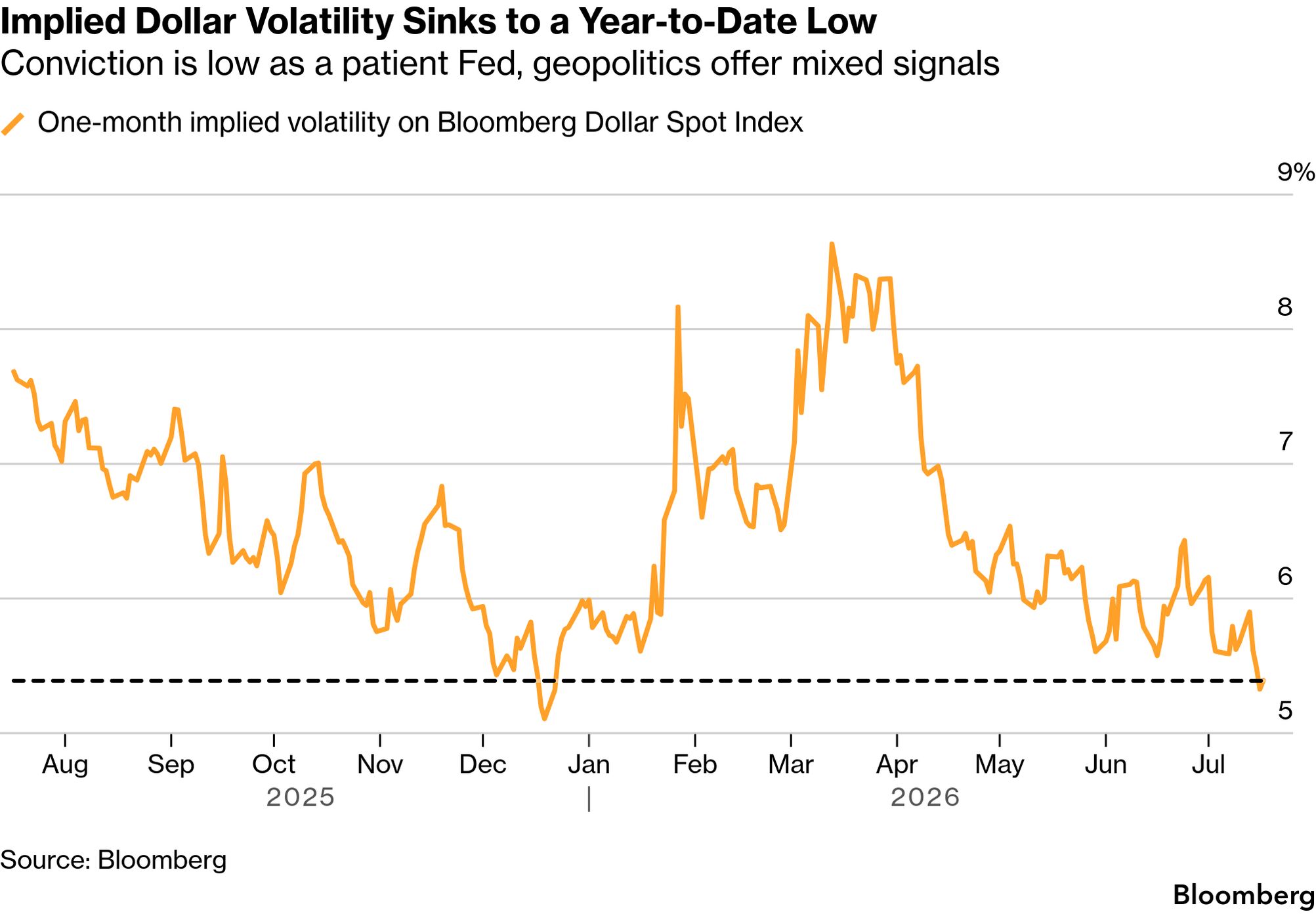
The steadiness this year of the greenback — the world’s major reserve currency — has been a decisive part of the setup for carry, filtering through exchange-rates globally.
With US inflation cooling more than expected in June and traders increasingly seeing the Fed on hold until later this year, a measure of one-month implied volatility on the last week sank to its lowest since December.
“The strategy has worked so far in spite of geopolitical tensions and angst about the glide path of US monetary policy,” said Hari Hariharan , chief executive officer at New York-based hedge fund NWI, who likes a few select carry trades.
He expects high-yielding currencies including Brazil’s real to fare well against the euro, the yen and euro proxies such as the Polish zloty. Brazil’s and Colombia’s currencies have delivered total returns of at least 15% against the dollar this year.
Risk Abounds
There is, of course, plenty of risk in leaning into the carry trade. Because it relies on picking up incremental bits of yield over time, big moves in exchange rates — like at the outset of the Iran war almost five months ago, or during the tariff shock of early 2025 — can wipe out returns.
Investors don’t have to look back too far for a reminder of how quickly the strategy can unravel.
In August 2024, a hawkish repricing of Bank of Japan policy triggered a surge in market volatility and . That sparked to exit leveraged positions as traders rushed to repay loans in the Japanese currency, fueling a brief meltdown in global financial markets.
The yen, which is around its weakest level in decades, is still a major funding currency. Hedge funds’ net short against the yen is close to the biggest since 2007, Commodity Futures Trading Commission data show. However, market watchers say BOJ policy expectations are better priced in than a couple years ago.
“The comparison with the summer of 2024 is instructive but should not be overstated,” said Laura Cooper , global investment strategist and head of macro credit at Nuveen. “A sharper yen rally could still unsettle risk assets broadly, but another disorderly global carry-trade unwind appears less likely.”
Fed Watch
At Standard Bank, Steven Barrow says he expects strong carry-trade returns will likely continue for now. However, he’s watching the Fed, where Chairman Kevin Warsh has promised . Investors anticipate that could mean less forward guidance on policy.
“What we fear most is not just a hike from the Fed, but one that is delivered without any forewarning from Fed members,” the bank’s head of G-10 strategy said in a note last week.
Investors worried about the dollar outlook or the threat that Japanese authorities will intervene to support the yen are , turning to the Swiss franc and the Australian dollar, in addition to the euro.
“This ‘all-weather’ approach has historically enabled investors to maintain exposure to the structural EM carry opportunity while avoiding an outright directional stance in what could be an uncertain US dollar environment,” said Thierry Larose , a portfolio manager at Vontobel.