Hong Kong’s Offshore Yuan Market Evolves Into Global Funding Hub
A record pile of yuan in Hong Kong is making its way to corporate loans while driving a surge in capital market activity, signaling that China’s drive to internationalize its currency is advancing.
Banks are driving the shift as borrowers seek to tap lower Chinese interest rates. Standard Chartered Plc said clients are increasingly seeking longer-dated yuan facilities for working capital and cross-border capex, moving well beyond traditional trade settlement. Bank of China (Hong Kong) said it has seen an increase in both the number and size of its offshore yuan loans.
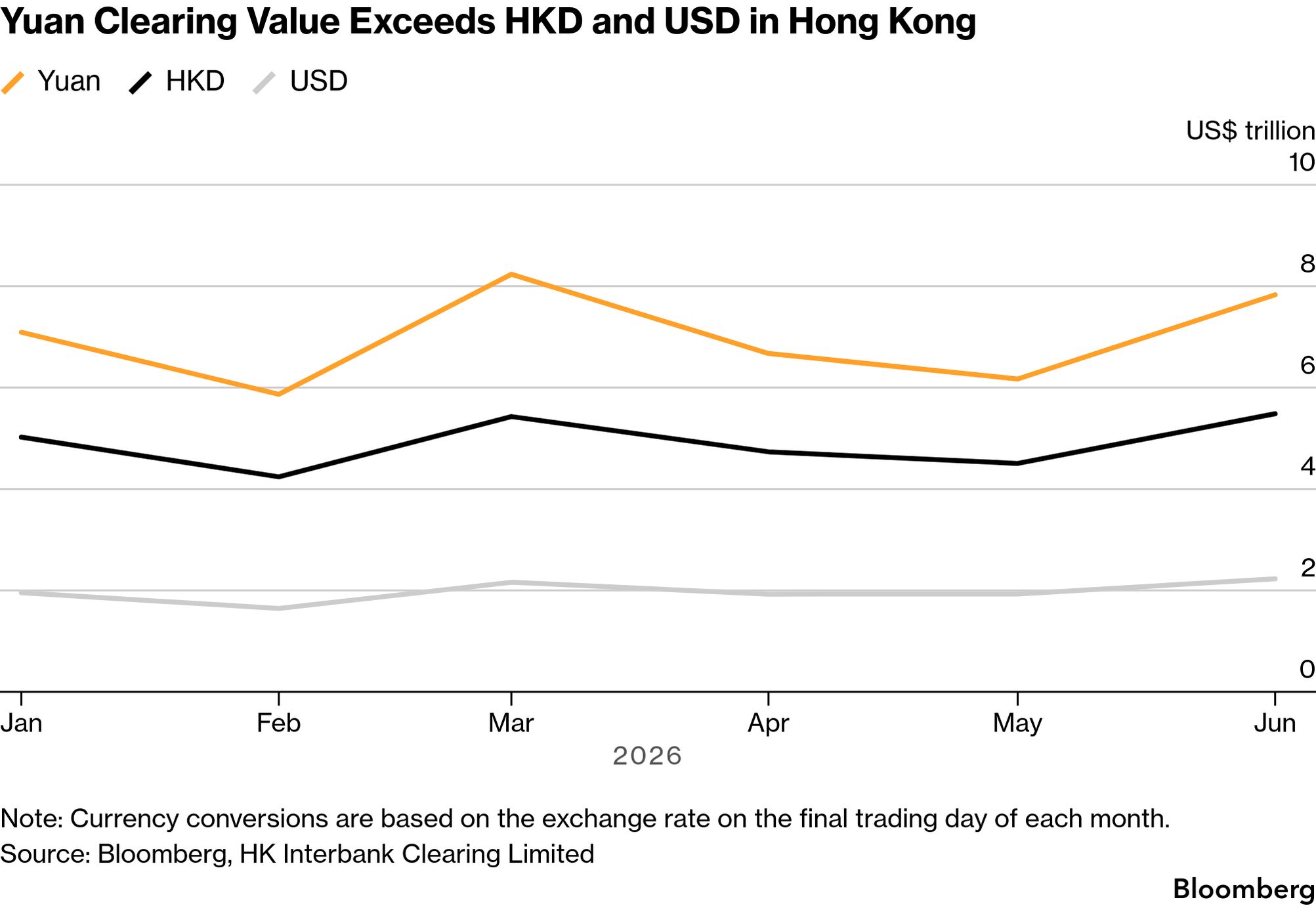
The demand has boosted transaction velocity across Hong Kong’s electronic interbank network. Yuan clearance volume in the city rose to ($7.9 trillion) in June, with overall settlements in the currency exceeding those in the Hong Kong dollar and US dollar, Hong Kong Interbank Clearing Ltd. data show.
“We are in a new phase of acceleration of the yuan’s internationalization,” said Karen Ng, Standard Chartered’s head of China opening and RMB Internationalization. The deeper liquidity pool in the offshore market is “truly enabling internationalization of the currency,” she said.
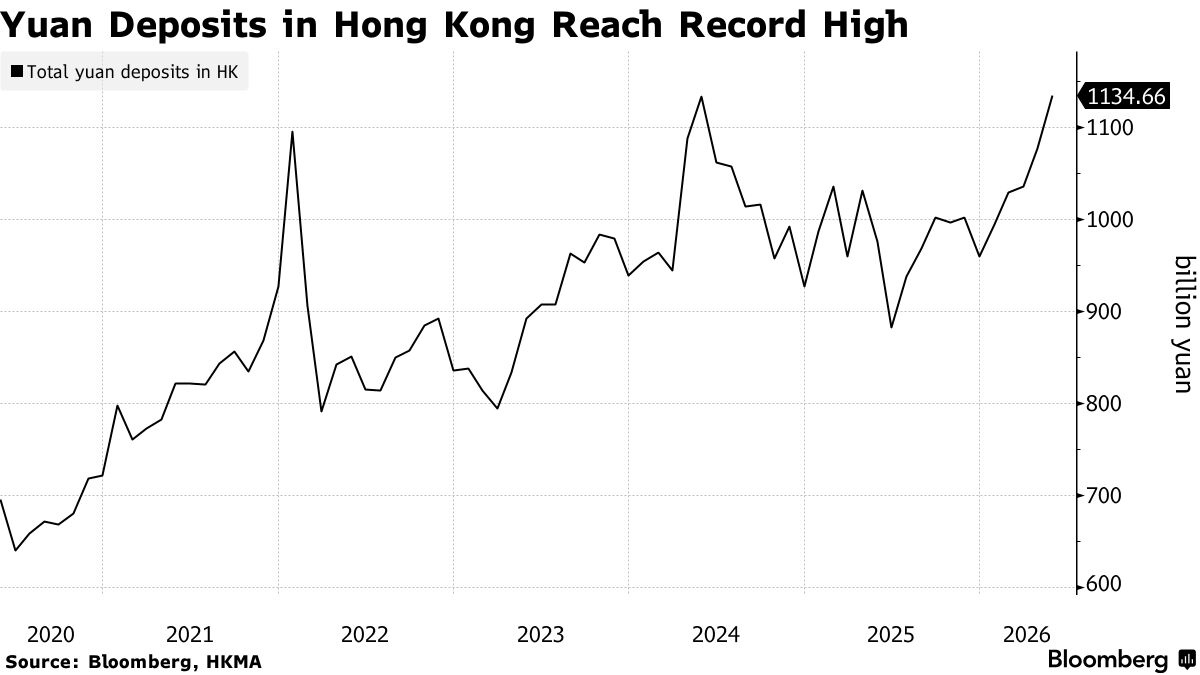
The liquidity surge reflects a broader shift as Chinese companies expanding overseas move their treasury, hedging, and financing activities to Hong Kong. That ecosystem pushed the city’s offshore yuan deposits to 1.13 trillion yuan at the end of May, a record high, according to Hong Kong Monetary Authority data.
A wave of offshore yuan debt issuance has also bolstered the liquidity pool. Global sovereigns and corporates issued 630.3 billion yuan of offshore yuan bonds year to date, up 33% from the amount raised during the same period in 2025, according to data compiled by Bloomberg. About 250 million yuan of offshore yuan loans have been arranged so far this year, following a record 42 billion yuan in all of 2025.
The debt issuance has fueled demand for hedging tools. Outstanding notional yuan over-the-counter interest-rate derivatives in Hong Kong surpassed those of their US dollar counterparts for the first time in October 2025, while Hong Kong dollar derivatives remained steady.
The borrowing demand led the HKMA to announce the in September, a program backed by the de-facto central bank to provide banks with low-cost yuan funding. It replaced the RMB Trade Financing Liquidity Facility announced in February 2025.
Bank of China (Hong Kong) said in written comments to Bloomberg that it had provided yuan loans and trade-finance services to more than 30 companies from February-December 2025 under HKMA’s RMB lending facilities for corporates. It also said that the maximum withdrawal on a single tranche reached one billion yuan in December under the upgraded RMB Business Facility, compared with 400 million yuan in March 2025 under the RMB TFLF.
Earlier this month, the size of the RMB Business Facility was to 500 billion yuan after more than 90% of the old limit was allocated. Authorities also raised the quota of the Southbound Bond Connect, which allows mainland institutional investors to buy offshore bonds through Hong Kong, to 800 billion yuan.
Officials are also exploring a new bidding mechanism for a seven-day offshore yuan liquidity facility and short-term yuan debt instruments. The new policies reflect ambitions to strengthen Hong Kong’s status as the world’s biggest offshore yuan hub at a time when rising geopolitical tensions spur doubts over the US dollar’s dominance.
Underpinning the policy support is the wide interest rate gap. China’s Shanghai Interbank Offered Rates, to which the RMB Business Facility is linked, are much lower than their US counterparts. The three-month SHIBOR trades around 1.43%, compared with 3.63% of the US Secured Overnight Financing Rate .
Borrowing in the offshore yuan is gaining popularity as China’s interest rates are lower than other major currencies, according to Cheuk Wong , head of markets and securities services at HSBC Holdings Plc in Hong Kong.
Standard Chartered is increasingly channeling yuan raised in Hong Kong to clients in Southeast Asia, the Middle East, and Africa to finance China-linked supply chains and projects in natural resources, electric vehicles, and manufacturing, Ng said.
That global reach relies on around two decades of market opening, built on direct links such as Stock Connect, Bond Connect, and Swap Connect that allow global investors to trade mainland assets through Hong Kong.
“We are transitioning from RMB accumulation to RMB intermediation,” said Bosco Wu , a strategist at the Bank of East Asia.
“In the earlier phase, the question was how to bring more RMB offshore to set up the robust liquidity pool. In the current phase, the question is how to make offshore RMB circulate efficiently through balance sheets and capital markets between Mainland China and overseas,” he said.